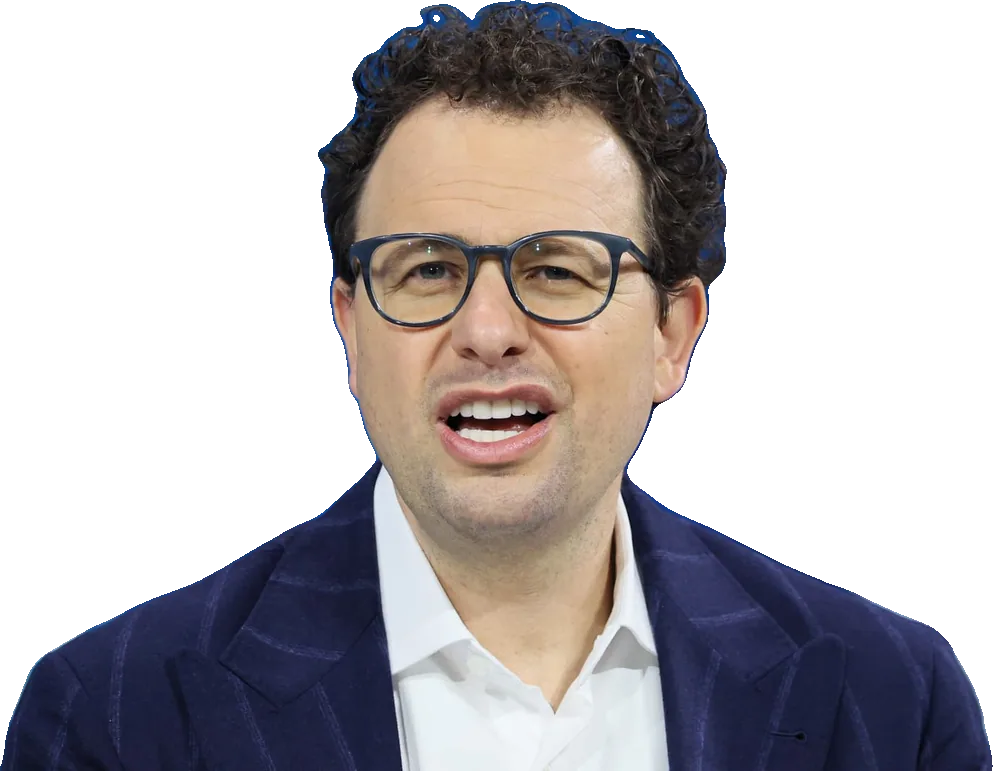
How Anthropic Went From AI Safety Outcast to the World’s Most Important Company
How Anthropic Went From AI Safety Outcast to the World’s Most Important Company
Get the podcast version


In 2022, a small team sat down to talk, for the first time, to an AI chatbot that actually seemed able to talk back. The researcher who went first didn’t try to trip it up, and he didn’t give it some fancy knowledge test. He typed “Hello.” The chatbot answered, “Hi there. How can I help you today?”
The early versions of that chatbot were painfully careful. Asked about a Jewish deli, it gave a lecture on antisemitism. Asked for a killer guacamole recipe, it accused the person of plotting a murder.
Everyone in the room was excited. Time later described a team in awe of what it had built. Some of them were also terrified. Some were worried enough that they pushed to keep the chatbot from being released at all. Several of the founders had ruled out turning it into a product, at least for the moment. The CEO was afraid that putting it out would start an arms race between AI companies to build bigger and more dangerous systems. He described their position as the classic prisoner’s dilemma. So despite the excitement and the awe, they kept it inside the building.
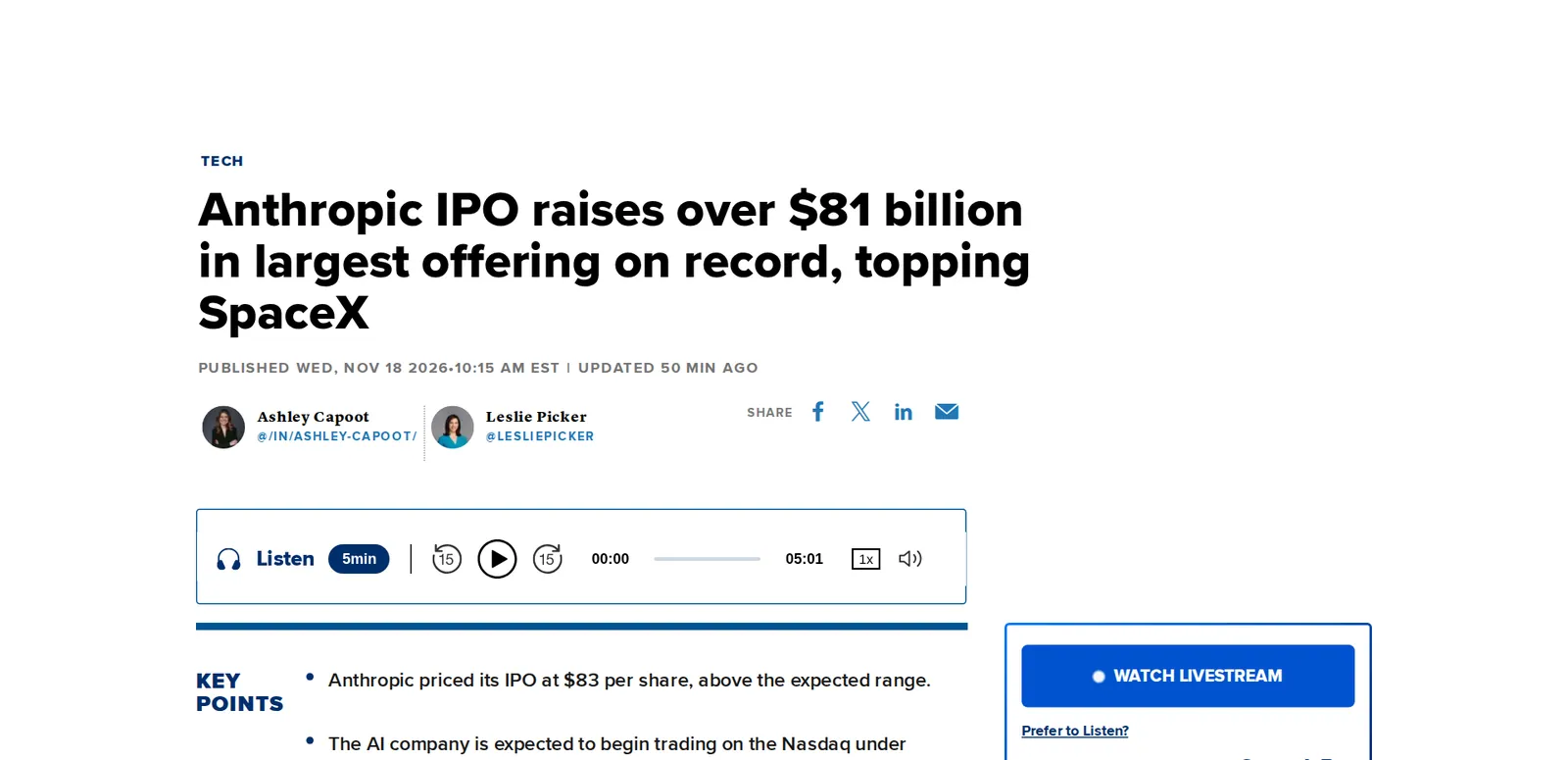
As you might have guessed by now, that team was not OpenAI, the creator of ChatGPT. It was Anthropic, the company that just went public in a record-setting IPO. Back in 2022, there weren’t many people who could have foreseen its ascent to the fastest-growing company of all time.
Unfortunately for that team, keeping the chatbot inside the building didn’t prevent the race. In the fall of 2022, a rumor started flying around San Francisco’s AI scene: Anthropic was about to release a chatbot, and it was good. The rumor reached OpenAI, which was busy getting GPT-4 ready for the following spring. OpenAI had discussed releasing a chatbot before, and had always decided to focus on improving its models instead. With the rumor in hand, one of OpenAI’s cofounders, John Schulman, pushed to rush out a free chatbot on the existing GPT-3.5 model so that OpenAI would be first. He convinced the team. On November 17, OpenAI’s chief technology officer, Mira Murati, told staff that a chatbot would be out by the end of the month.
On November 30, 2022, OpenAI released ChatGPT. Within five days, a million people had signed up. From then on, ChatGPT was synonymous with AI, and OpenAI was officially out ahead of Anthropic.
That wasn’t even Anthropic’s only disaster that month. Nineteen days earlier, the company’s single biggest investor, Sam Bankman-Fried, had put his crypto exchange, FTX, into bankruptcy. As more and more came out about his fraud, the team at Anthropic worried that the bankruptcy estate would come knocking, even though they had already spent almost all of the $500 million he had put in. Jack Clark, one of Anthropic’s cofounders, said of that November: “It was an unbelievably bad month.”
FTX files for bankruptcy
Mira Murati tells OpenAI’s staff a chatbot is coming
ChatGPT launches
1 million users in five days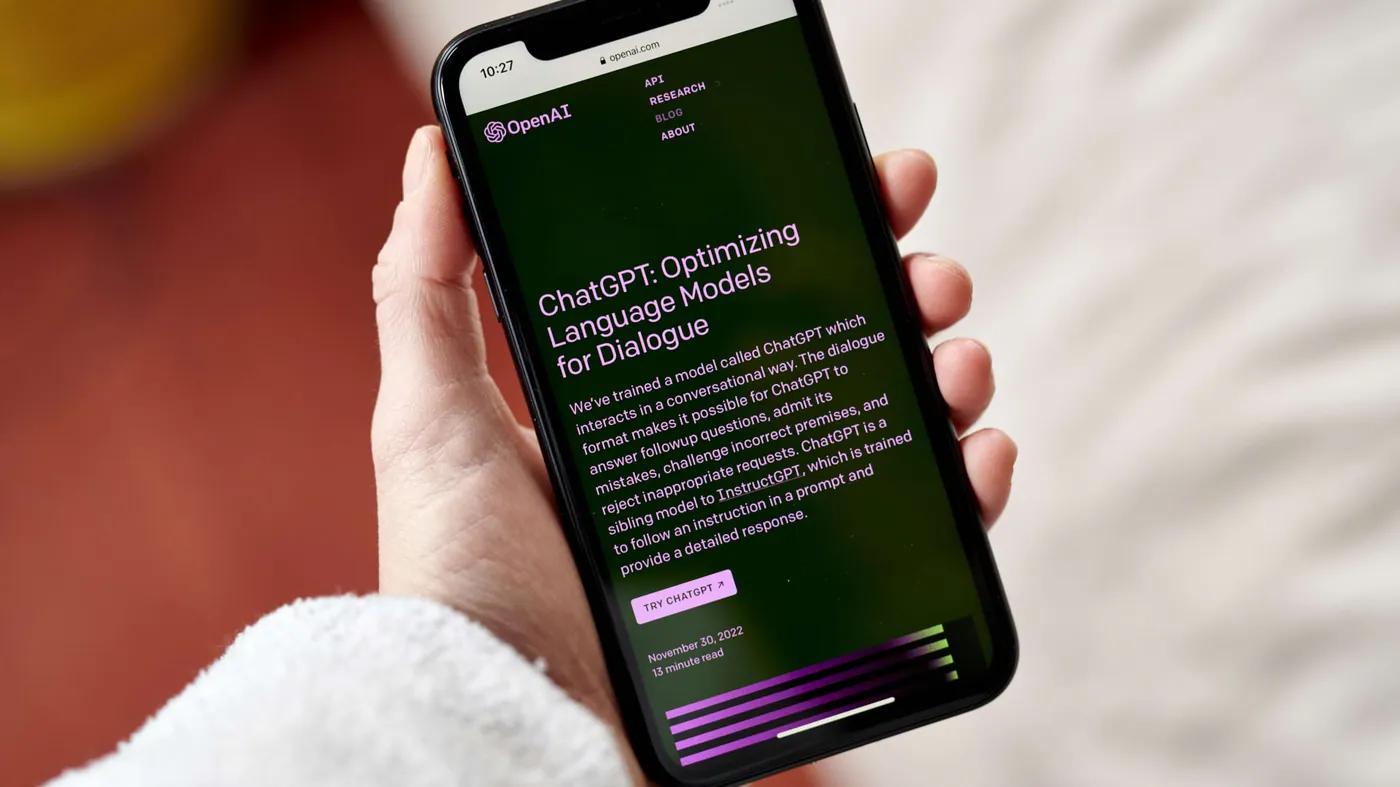
This is the story of a company rocked on its financial heels and, at least in part because of its own decisions, cursed to perpetually play catch-up in public perception. It’s about a company that had been so worried about the safety implications of its own products that it didn’t release them even when they were ready. And it’s the story of how that company became not only the most significant in AI but, with its IPO and according to many investors, the single most important company in the world.
The People Most Afraid of AI Decide to Build It
Anthropic’s founders were the people most convinced that bigger AI would be smarter AI. They were also among the people most convinced it could end the world.
The effective altruists
Their fear came out of two communities that grew up alongside each other in the late 2000s. The first was the effective altruists. The EA movement started with a simple question: if you want to do good with your money, where does a dollar go the farthest? In 2007, a charity evaluator called GiveWell tried to answer it with data, ranking charities by how many lives they saved per dollar. The people drawn to that way of thinking gave away large shares of their income, and some even started choosing careers by how much good they could do. By the mid-2010s, much of the movement had turned to the long term. If the goal is to do the most good, then people who haven’t been born yet count too, and things that could wipe out humanity, like a pandemic or AI gone wrong, start to look like the biggest problems there are. Open Philanthropy, a grantmaker funded by Facebook cofounder Dustin Moskovitz, would go on to pay for much of the early AI safety field.
The rationalists
The second community was the rationalists. They gathered around Eliezer Yudkowsky’s blog, LessWrong, and their project was using probability and evidence to catch the mental errors that lead people to believe wrong things. When Yudkowsky applied that way of thinking to AI, he concluded that a machine smarter than us would pursue its goals with total efficiency. Unless those goals matched what humans want, which is very hard to get exactly right and which no one knows how to do, we would simply be in its way. The AI, as he put it, “does not hate you, nor does it love you,” but you are made of atoms it can use for something else. The rationalists gave the problem the name it still has, alignment: making sure an AI’s goals line up with ours before anyone builds one smarter than us.
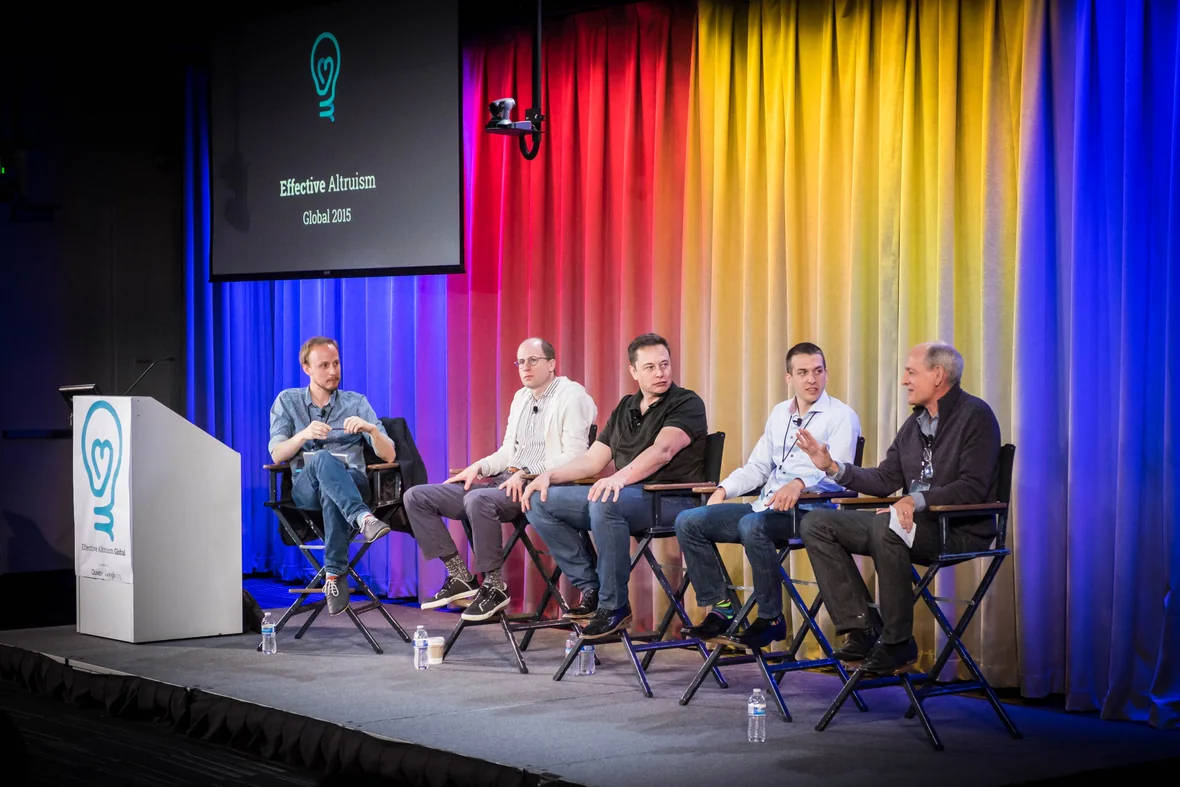
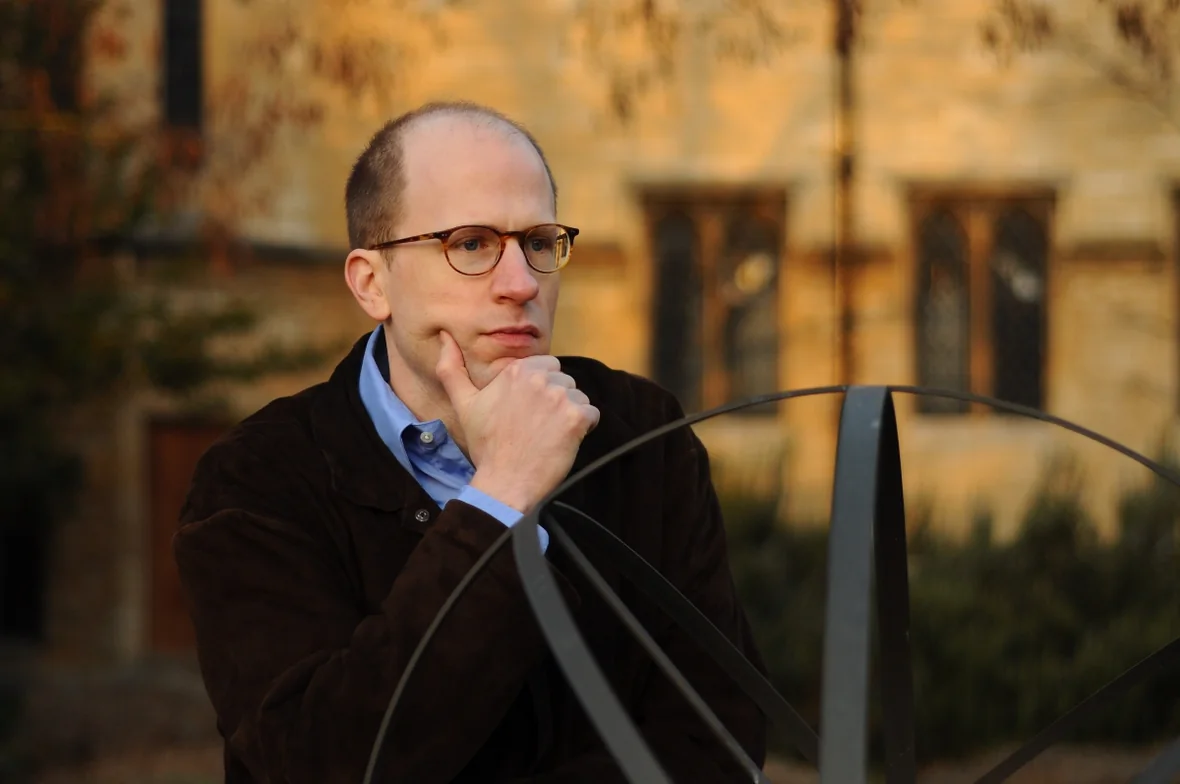
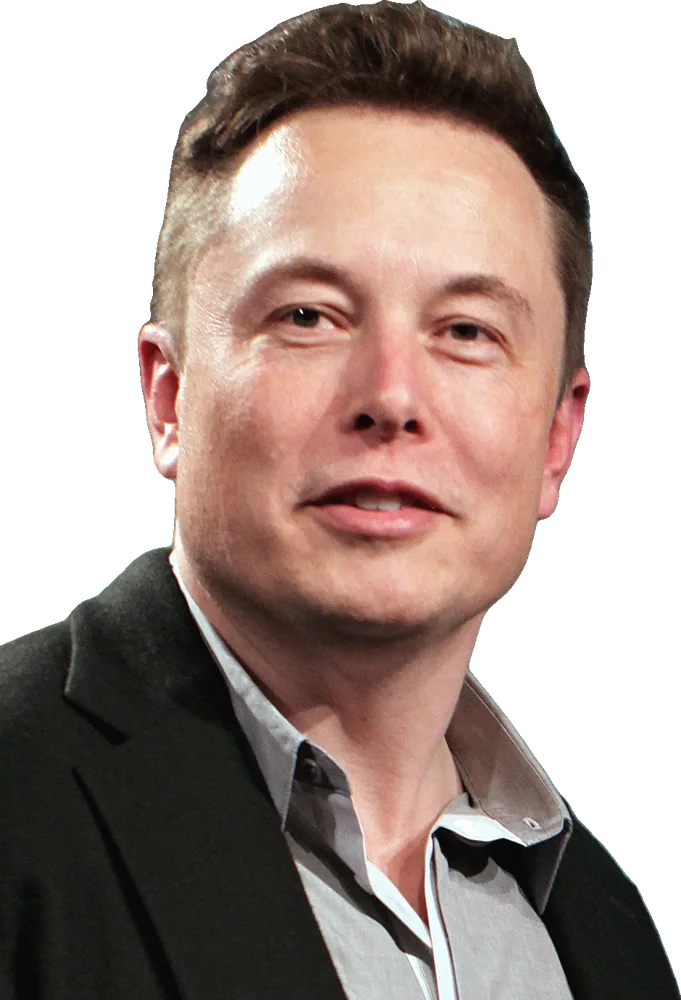
In 2014, the philosopher Nick Bostrom took that argument to a much more mainstream audience with his book Superintelligence. Among its readers was Elon Musk, who posted: “We need to be super careful with AI. Potentially more dangerous than nukes.”
Dario Amodei, Anthropic’s cofounder and CEO, was close to both worlds without belonging to either. As a grad student, he gave GiveWell $10,000, about half his stipend. The size of the donation, especially relative to its source, caught the notice of GiveWell cofounder Holden Karnofsky. The two met and became friends, and Holden would eventually marry Dario’s sister, Anthropic cofounder Daniela. Dario later signed a pledge to give away at least 10% of his income. When it came to the rationalists, he disagreed with plenty of Yudkowsky’s specifics but agreed that a misaligned AI smarter than humans could be a catastrophe.
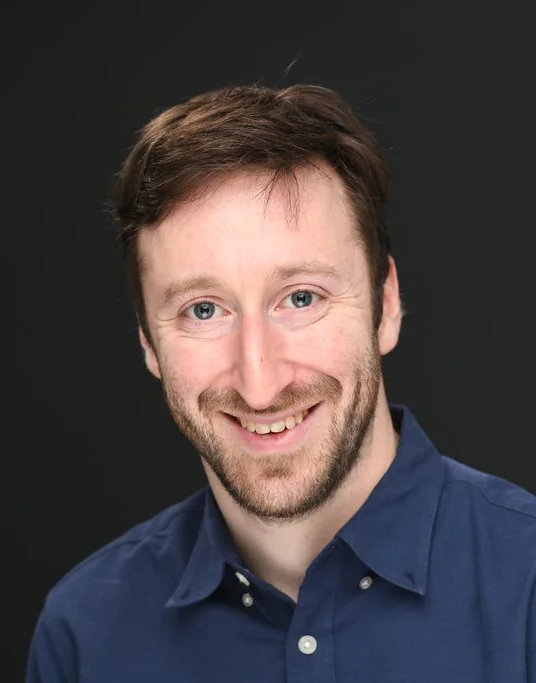
By late 2015, Dario was working at Google and sharing a house in San Francisco with a number of other people concerned about the same issues. They included Karnofsky, the AI safety researcher Paul Christiano, and the neural-network pioneer Chris Olah, who would eventually cofound Anthropic with Dario.
Dario and his housemates were far from the only people arriving at these fears. A few years earlier, Musk had put $5 million into DeepMind, a London lab whose founder, Demis Hassabis, had stated openly that his goal was to build the first general artificial intelligence. Musk invested, by his own account, at least partly to keep an eye on it. In 2014, Google bought DeepMind. Musk’s friend Larry Page, Google’s cofounder, talked about AI as the next stage of evolution. When Musk said he worried AI could wipe out humanity, Page called him a “speciesist.”
In 2015, Sam Altman, then running the startup incubator Y Combinator, wrote to Musk that he’d been thinking a lot about whether it was possible to stop humanity from developing AI, and that he thought the answer was almost definitely not. If it was going to happen anyway, he wrote, it would be good “for someone other than Google to do it first.” Ironically, Anthropic’s founders would make the exact same argument six years later, with OpenAI in Google’s place.
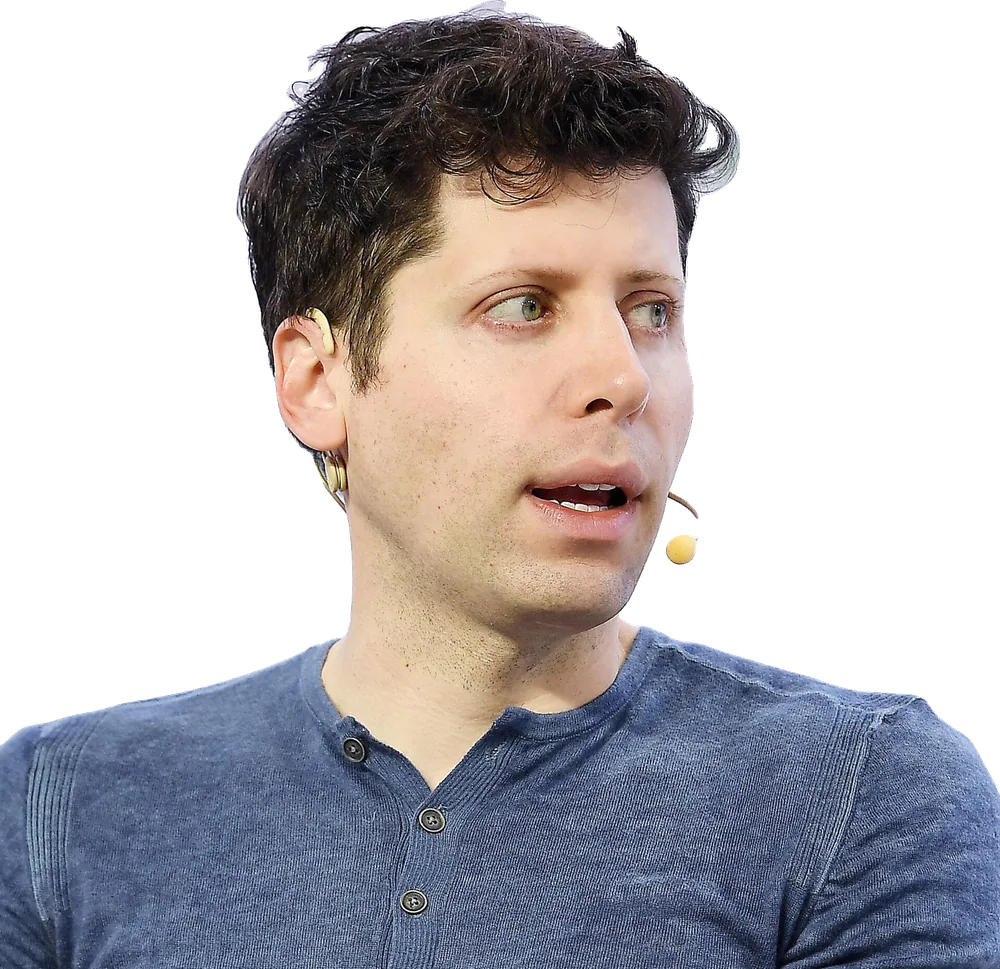
That summer, over dinner at the Rosewood Hotel on Sand Hill Road, Altman, Musk and a handful of AI researchers talked through starting a lab of their own. They recruited the engineer Greg Brockman from Stripe and pulled the researcher Ilya Sutskever away from Google, which fought very hard to keep him. Musk later said the fight over Sutskever ended his friendship with Page.
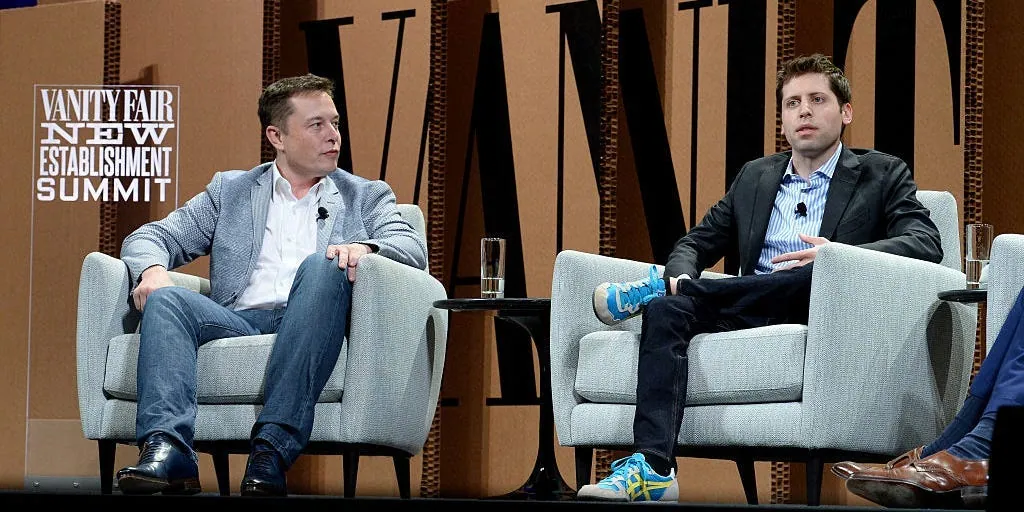
On December 11, 2015, OpenAI launched as a nonprofit with $1 billion in pledges from Musk, Altman and other Silicon Valley icons like Peter Thiel and LinkedIn founder Reid Hoffman. Its stated goal was to advance AI in the way most likely to benefit humanity as a whole, “unconstrained by a need to generate financial return.” The billion dollars was mostly a number for the announcement. Musk had argued that starting with just $100 million would sound hopeless next to Google. By OpenAI’s count, the nonprofit raised less than $45 million from Musk and around $90 million from everyone else. At the time, Musk rallied the troops. “We are outmanned and outgunned by a ridiculous margin,” he wrote, but they had right on their side, and that counted for a lot.
The billion dollars
Before long, OpenAI was recruiting both research talent and people concerned about AI safety, and eventually it got Dario’s whole house. Dario, Olah and Christiano went, and were later joined by Daniela Amodei and the theoretical physicist Jared Kaplan, another eventual Anthropic cofounder.
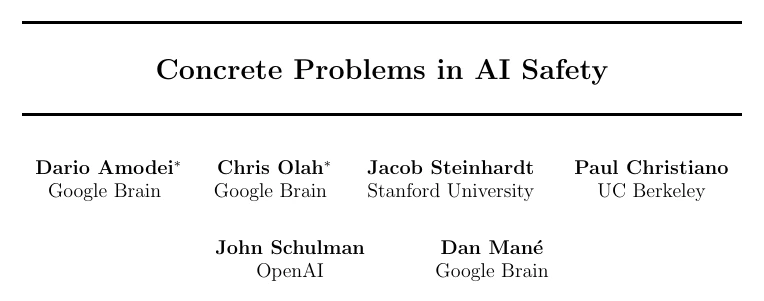
In 2016, Dario, Olah, Christiano and a few others wrote a paper called “Concrete Problems in AI Safety.” It was one of the first attempts to turn fears about AI into research problems an engineer could actually work on. To get it past Google’s nervous publication review, they swapped rogue superintelligences for a cleaning robot that knocks over a vase to finish its job faster. In 2017, Christiano and Dario, working with researchers at DeepMind, published a way to teach an AI what people want: show a person two of its attempts and ask which one is better. Under the name reinforcement learning from human feedback, or RLHF, it became the technique OpenAI later used to turn its language models into a chatbot people could talk to.
Most of the field was looking somewhere else. One fun fact, given how things played out: it was Google researchers, not OpenAI’s, who invented the transformer, the design behind every modern chatbot. In 2017, most people in AI barely noticed. When OpenAI’s first GPT model came out in 2018, the most prestigious AI conference rejected the write-up, and researchers told its author they didn’t understand why he was bothering with language models at all. Gwern Branwen, one of the few outside writers who saw it coming, wrote that Google Brain and DeepMind simply didn’t believe in scaling the way Sutskever, Dario and others at OpenAI did. He called their view an “extreme fringe lunatic theory,” which, of course, ultimately turned out to be correct.
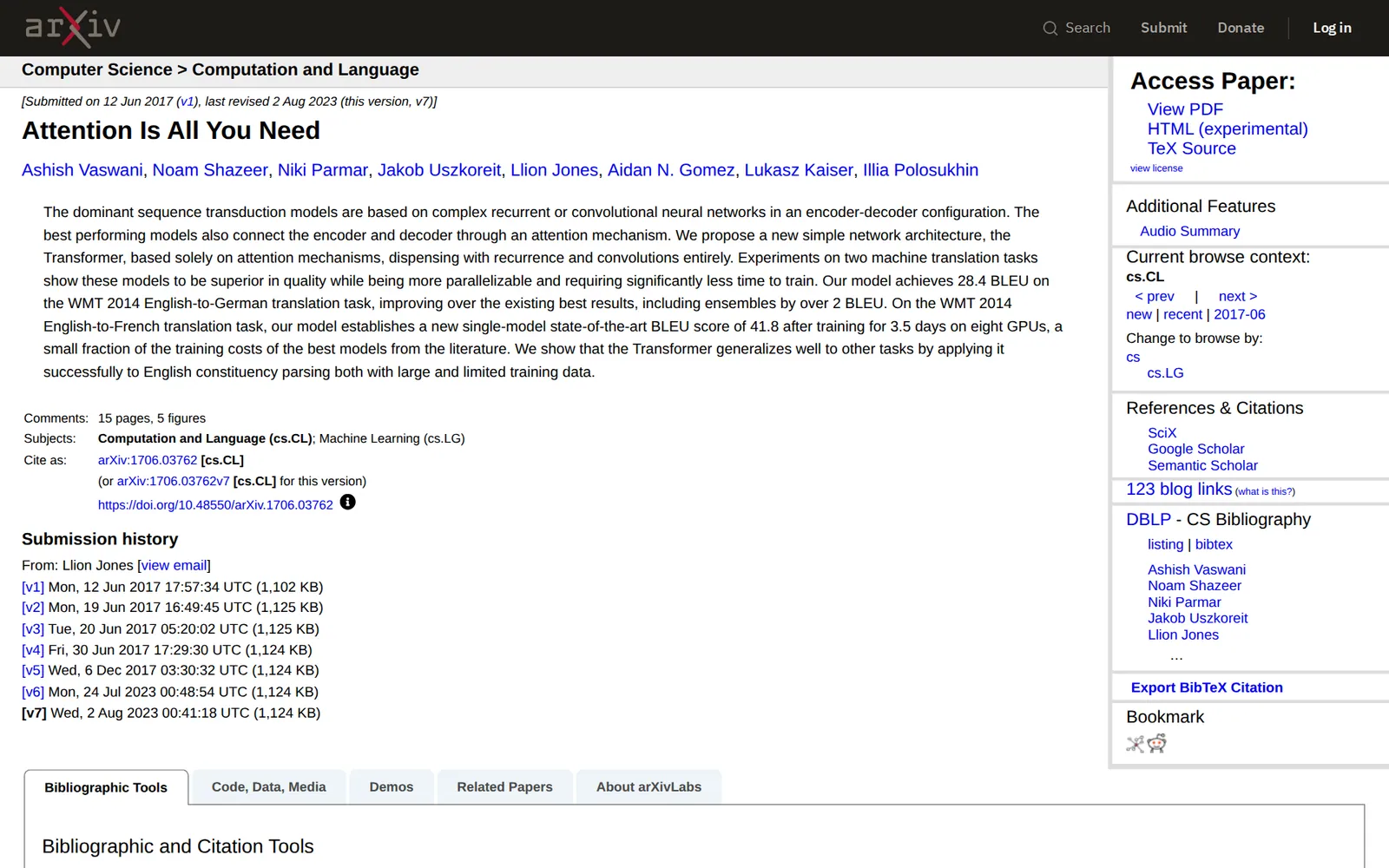
The group that would eventually leave to found Anthropic had a hand in most of the ideas the AI industry now runs on: RLHF, looking inside models to see how they work, and, importantly, betting on scale.
In 2017, Dario wrote a 26-page memo called “The Big Blob of Compute.” Its argument was that intelligence would come mostly from piling up three ingredients: computing power, the size of the model, and data. Without enough of all three, he wrote, nothing could save you. Most AI researchers, he wrote, were overthinking it. They were building complicated algorithms for narrow tasks and micromanaging their models, when most progress came from one simple recipe, which was to make the models bigger. He’d seen it firsthand at Baidu, where a speech recognition system kept getting better the bigger they made it. Clever handwritten rules wouldn’t matter much. These systems were grown more than built.
Two years later, the computer scientist Rich Sutton gave the idea its fullest expression and its best-known name, “the bitter lesson.” Looking back at 70 years of AI research, Sutton wrote that the researchers who tried to build their own knowledge into their systems, in areas like chess, Go, speech and vision, kept getting beaten by simpler systems running at a bigger scale, and that the methods that make use of more computing power win by a large margin. “Scale is all you need” became the field’s shorthand for taking that lesson all the way. If Dario and Sutton were right, powerful AI was coming much sooner than almost anyone thought, and its winners would be whoever could afford the most chips. Kevin Roose, the author of The AGI Chronicles, argues that the Big Blob memo is where the AI race actually started.
In December 2018, OpenAI finished training GPT-2, and some of the people closest to it were alarmed by how good it was. GPT-2 had only been trained to predict the next word, and yet it could answer trivia, summarize, and write in the voice of a Wikipedia article, a Reddit post or a scientific paper. In an example OpenAI later made public, it was given two sentences about scientists discovering a herd of English-speaking unicorns in the Andes and wrote the rest of the news story, complete with a made-up evolutionary biologist from the University of La Paz and quotes attributed to him. One researcher recalled the mood inside OpenAI as, more or less, “What the fuck?”
In a shocking finding, scientist discovered a herd of unicorns living in a remote, previously unexplored valley, in the Andes Mountains. Even more surprising to the researchers was the fact that the unicorns spoke perfect English.
MODEL COMPLETION (MACHINE-WRITTEN)
The scientist named the population, after their distinctive horn, Ovid’s Unicorn. These four-horned, silver-white unicorns were previously unknown to science.
Now, after almost two centuries, the mystery of what sparked this odd phenomenon is finally solved.
Dr. Jorge Pérez, an evolutionary biologist from the University of La Paz, and several companions, were exploring the Andes Mountains when they found a small valley, with no other animals or humans.
↙ everything after it
is the model
Dario, who ran research at OpenAI at the time, was one of the most alarmed. Where others saw something between a neat parlor trick and a portent of things to come, Dario saw a weapon. A model that could write a convincing story about unicorns could also write convincing propaganda, fake news and phishing emails at a scale no troll farm could match. In long, tense meetings, his safety team asked what would happen if an authoritarian government used it to flood the internet, and whether they would end up with blood on their hands. Jack Clark, then running policy, pointed to a Neal Stephenson novel in which the internet drowns in synthetic spam and conspiracy theories until society breaks down.
Dario didn’t want the finished model released at all, and he wanted a rule against ever releasing anything bigger. In one meeting, pounding the table, he said OpenAI should set a precedent right then that it would never release a model bigger than 3 billion parameters. GPT-2 was 1.5 billion. To give a sense of how much things have changed: the biggest open models today, the ones with their weights fully available to the public, are up near 3 trillion parameters, a thousand times bigger than the limit Dario wanted to set. And it is likely that the biggest closed models, like Anthropic’s Fable, are bigger still.
A thousand times the limit
Other executives thought the fears were overblown, and that holding the model back while bragging about it would look like hype. They settled on a compromise: publish samples and a small version, and keep the full model inside.
This seemed to be Dario’s natural instinct, both then and later. Assume the worst and hold the thing back. A former colleague described how he won arguments. Dario had a habit at the time of just announcing that they had to do something because it was the morally correct thing to do.
That kind of certainty is one of the best-known criticisms of the rationalist and EA world. The concern is that if you reason your way to a conclusion carefully enough, it’s easy to treat the conclusion as settled. Anyone who disagrees with you stops being someone with a different opinion and becomes someone who wasn’t smart enough to follow the argument to its logical conclusion. To be fair to those communities, outsiders aren’t the only ones who have identified that particular problem. As early as 2013, one of the movement’s most-read writers, Scott Alexander, argued that a bad argument can feel just as convincing as a good one, and that for most people, taking every clever argument seriously is a mistake.
And yet, if GPT-2 raised a lot of uncomfortable questions about the trajectory of AI, it also proved Dario’s theory about adding more compute pretty much correct. He described the results as almost mathematically predictable, like a simulation. The model had cost about $5,000 to train on 100 GPUs, and as he saw it, they could add eight more zeros to that.
Two other eventual Anthropic cofounders, Jared Kaplan and Sam McCandlish, turned this into what became known as the scaling laws, published in January 2020. Models got better on a predictable curve as you added computing power, data and size. Kaplan said the lines were straighter than they’d expected, more like what you’d get in a physics experiment.
The implications of the scaling laws were clear, and concerning. In the summer of 2019, Dario wrote a document called “The Path to AGI” and stamped “infohazard” on the cover. It predicted AGI as soon as 2021, built by 30 to 50 people for $1 billion to $2 billion. His own reaction to the scaling laws was that the discovery was exciting, and that it was also frightening.
So why would the people most afraid of AI decide to go out and build it?
One answer came from one of Dario’s favorite books, Richard Rhodes’s The Making of the Atomic Bomb, and its hero, Leo Szilard. Szilard was a Hungarian physicist who, standing at a London street corner in 1933, worked out that a nuclear chain reaction was possible, after Ernest Rutherford, the most famous physicist in Britain, had dismissed the idea. Szilard understood right away that it meant a bomb. He patented the idea and tried to keep it secret. When it looked like Nazi Germany might build one first, he drafted the 1939 letter, signed by Albert Einstein, warning President Roosevelt. That letter helped start the Manhattan Project, and Szilard himself helped build the reactor that produced the first chain reaction, in Chicago in 1942. And yet in July 1945, with the bomb nearly ready, he circulated a petition signed by dozens of Manhattan Project scientists urging President Truman not to use it on Japanese cities.
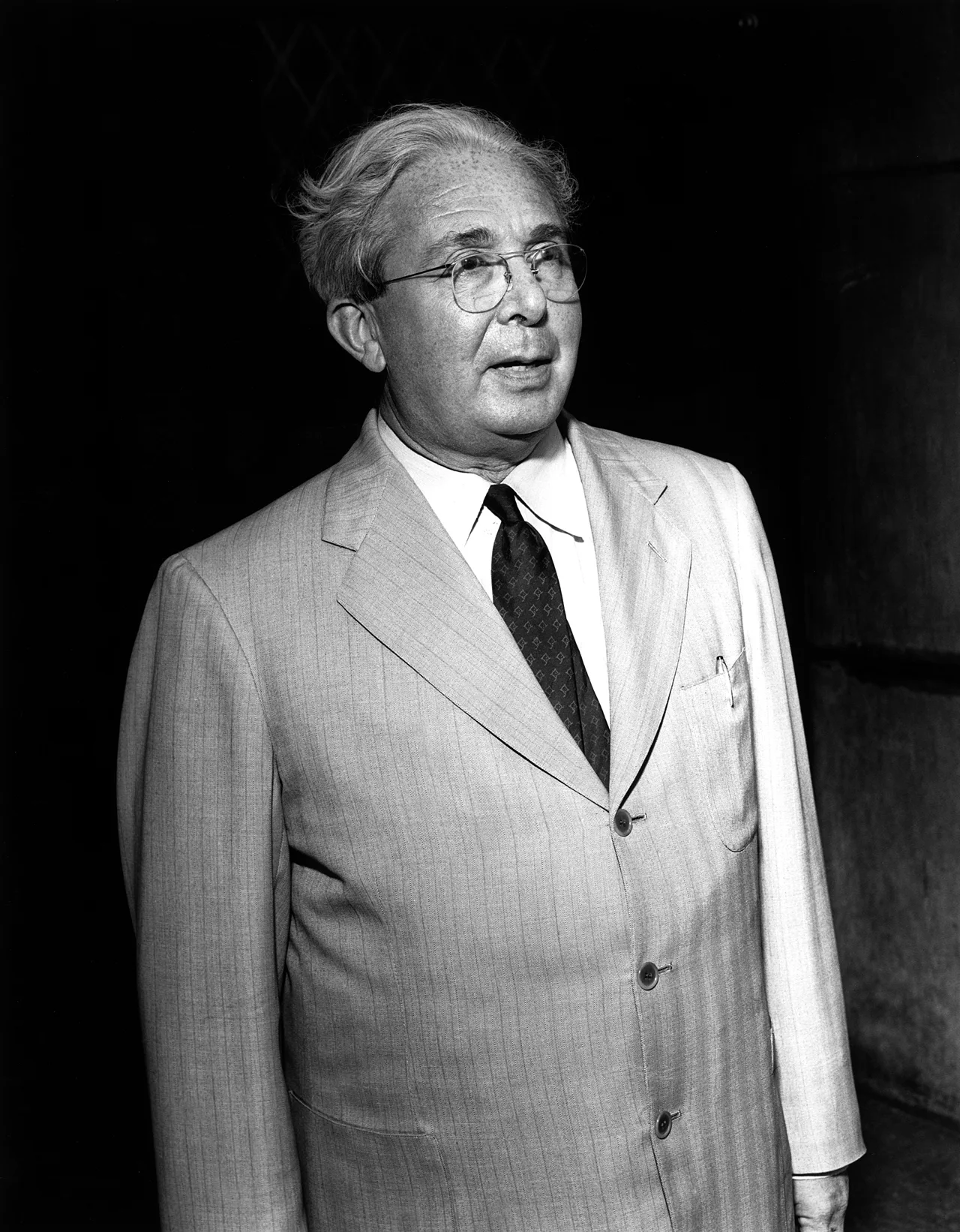
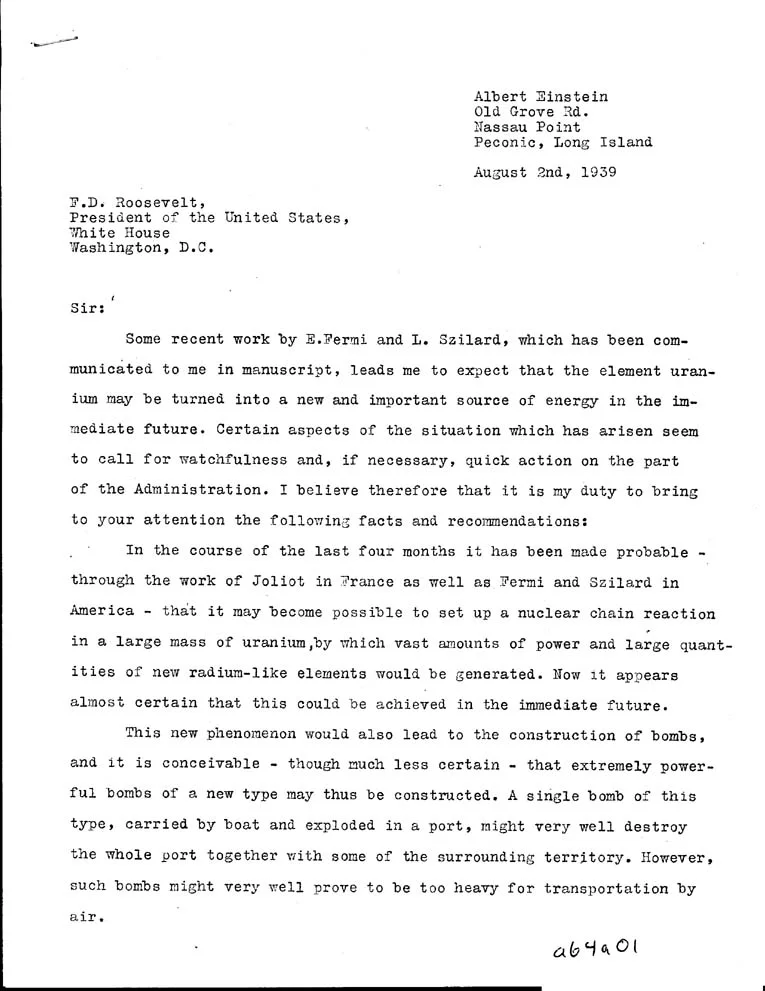
This was a model that made sense to Dario and many of the early AI researchers. If a terrifying technology is coming anyway, the people who understand the danger should be the ones building it, and then they should fight over how it’s used. At OpenAI, he even created a Szilard Award for researchers who made sacrifices in the name of safety.
The analogy, of course, came with a warning. Szilard got the bomb built, but he couldn’t stop it from being used. Anthropic later named this risk itself: that safety work at the frontier ends up accelerating the deployment of dangerous technologies. In its view, though, the alternative was worse, a world where the most safety-conscious research efforts only ever engage with systems far behind the frontier. Years later, Sam McCandlish would say that none of them wanted to found a company: “We just felt like it was our duty.”
One of the strongest objections to this way of thinking came from the people who had taught them to worry. To Eliezer Yudkowsky and his allies, building the thing in order to make it safe was the critical mistake. The title of his 2025 book sums it up: If Anyone Builds It, Everyone Dies. Every lab says it’s the responsible one that has to be at the frontier. A safety-minded lab in the race is still one more lab in the race, and a lab that proves safety research needs frontier models has handed itself a permanent reason to build bigger ones.
The founders’ answer, of course, was that the race was already on, and sitting out would hand the frontier to people who cared less. Whether that was wisdom or rationalization follows Anthropic through the rest of this story.
By 2019, Dario had lost faith in OpenAI’s leadership, and in Sam Altman above all. To take just one of the numerous examples that pushed him over the edge: Dario had written a clause into OpenAI’s charter promising that if a safer lab got close to AGI first, OpenAI would stop racing and help it. When the company eventually took funding from Microsoft, that provision was discarded. Altman told Dario that Microsoft wouldn’t accept it and that he’d had to make compromises. Dario came to believe that Altman had never fought for it at all.

Even then, starting a company wasn’t Dario’s first instinct. He’d considered quitting before and had always talked himself out of it, reasoning that fighting for OpenAI’s mission from the inside beat leaving the job to people who cared less. When he finally gave up on fixing OpenAI, his first thought was to go work at DeepMind, whose safety work he respected. It was Jared Kaplan who suggested gathering everyone at OpenAI who shared their views on safety and starting something together. Dario was skeptical. Did the world need one more company racing toward AGI? Would a mass exodus of safety people make OpenAI more dangerous? And if AGI was only a few years away, was there even time?
Still, the more he talked it through with the people who wanted out, the more he liked it: a lab stocked with OpenAI’s best researchers, where safety wouldn’t have to fight for resources. In 2020, Dario offered Altman conditions for staying, including a safety veto over releases. He expected a no, and he got one. Meanwhile, the group planning to leave set up a private Slack channel, and in December 2020 they told an all-hands meeting that they were leaving. Daniela had negotiated what they called the divorce, including a window to recruit OpenAI staff in exchange for not doing so once that window had closed.
By the start of 2021, although it didn’t have a name yet, Anthropic had officially been formed.
The Early Years
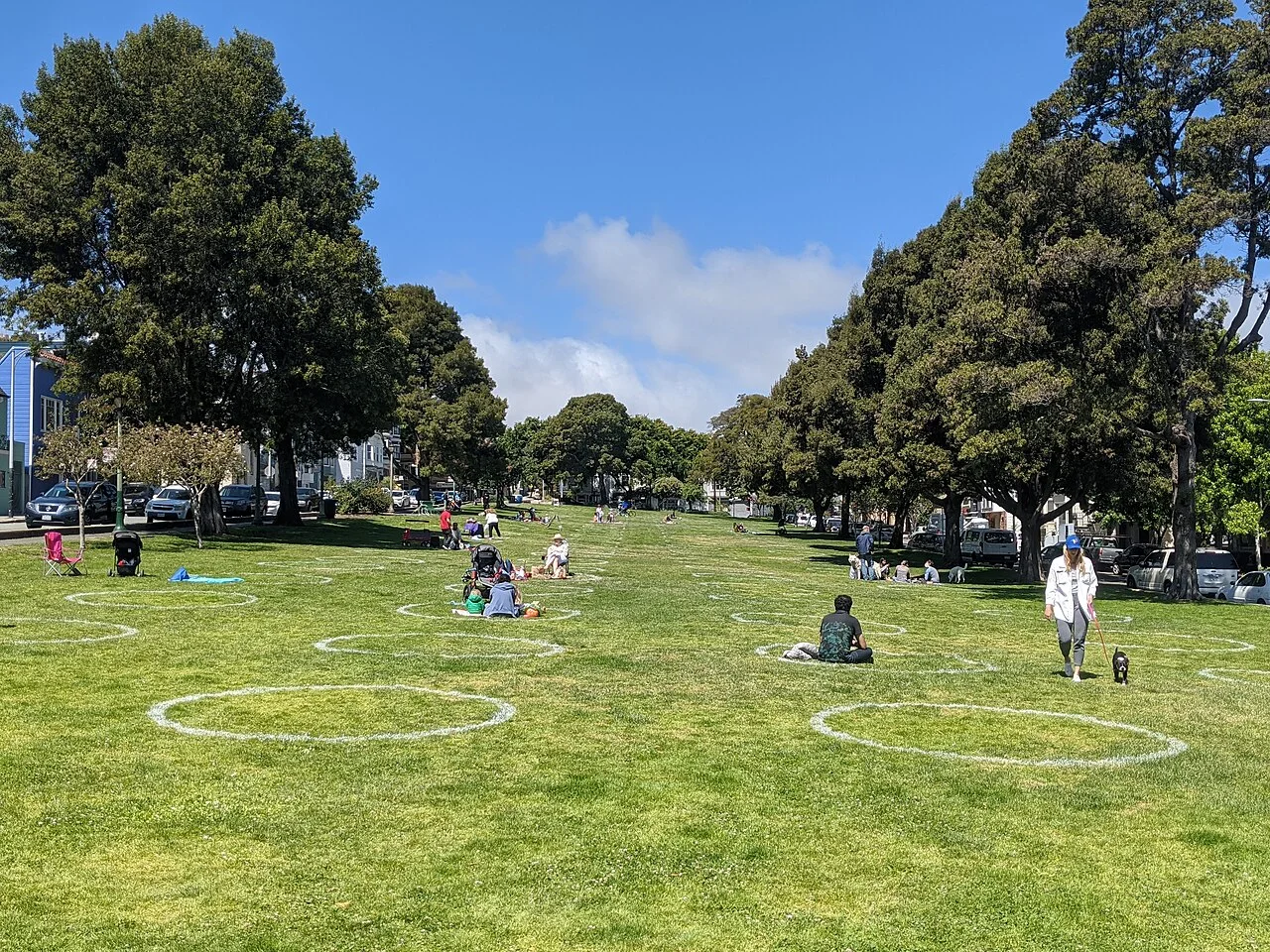
Anthropic did not start out as the juggernaut it became. The company’s staff meetings happened in Precita Park, on the north slope of San Francisco’s Bernal Hill. It was the middle of the pandemic, so they brought laptops and folding chairs and sat six feet apart. They went through a bunch of names and threw them out for being too esoteric, or for needing too much background knowledge to really understand. Eventually Jared Kaplan suggested Anthropic, from the Greek word for human. The domain name was available, so Anthropic they became.
They seriously considered becoming a nonprofit, to escape the commercial pressure they believed had bent OpenAI. When they concluded they couldn’t raise enough money or hire the best people that way, they became a public benefit corporation instead, with a trust that would eventually choose most of its board. Dario’s plan, in a memo called “Vision for a NewCo,” was a lab of no more than about 50 people that would build a model as good as GPT-4, then a coding assistant, then AGI, or artificial general intelligence: an AI system that could perform as well as or better than humans in most professional domains. He asked every cofounder to pledge 80% of their equity to charity. Some thought about haggling at first. Cofounder Tom Brown summed up why not to bother: the company was going to be worth either a trillion dollars or nothing.
Whatever the business structure, in the minds of the founders they were first and foremost a research lab. Their first announcement, with their funding round in May 2021, called Anthropic an AI safety and research company working to build “reliable, interpretable, and steerable AI systems.” Talking about money in those early days was basically haram. Several cofounders, Dario included, had explicitly ruled out commercializing anything. One early employee recalled that some people thought they shouldn’t make money at all, because AGI might be so soon. Everyone was extremely indecisive, and they didn’t run things like a business. When they did discuss making money, the ideas showed how badly they wanted to avoid a product. They talked about licensing the model to nonprofits, or running an AI-powered hedge fund.
The work itself was safety research on a large model of their own, trained on chips rented from Amazon. Chris Olah’s team tried to reverse-engineer what was happening inside the models, publishing “A Mathematical Framework for Transformer Circuits” in December 2021. Amanda Askell, a philosopher who had taught herself to code, led work on what an aligned AI should even be. In 2022 came papers on training an assistant with human feedback, on attacking their own models to find out what could go wrong, and on their vision for “constitutional AI,” a way to train a model to follow a written set of principles.
None of it was a product, and all of it needed a large model to work on. To do any of it, they needed money, and at first no one wanted to give it to them. The VCs they approached understandably pointed out that not only did they have no product, it wasn’t clear the team ever wanted to make one. Eric Schmidt, Google’s former CEO, thought their ideas were vague and their 50-person cap unrealistic, but decided they were good scientists and invested. The rest came from the safety movement. In May 2021, Anthropic announced a $124 million Series A led by Skype cofounder Jaan Tallinn, with participation from Dustin Moskovitz.
In 2022, their biggest check came from the most famous effective altruist in the world. Sam Bankman-Fried, the founder of the hedge fund Alameda Research and the high-flying crypto exchange FTX, offered $500 million for about 13% of the one-year-old company, and the money came with no board seat or other strings. Dario was nervous about taking that much crypto money, and that much money from a single investor. But they needed money, and he took it.
In early 2022, their model finished training, and they turned it into a chatbot so they’d have something to study. They named it Claude, after Claude Shannon, the father of information theory. On February 4, 2022, they switched it on in a Slack channel for employees, and by the fall a few dozen testers had access through a simple web page the team built to collect research data. The people closest to it were in awe of what they’d made. But they chose not to release it, to avoid setting off a race to build bigger and perhaps more dangerous AI systems. Dario would later say: “I suspect it was the right thing to do, but it’s not totally clear-cut.”
Then came November 2022.
On November 11, FTX filed for bankruptcy, and Anthropic’s biggest investor turned out to be running a fraud. Bankman-Fried had been funding bets at his trading firm with FTX customers’ money. It hit Anthropic in more ways than one. First, they had already spent most of the $500 million, and executives didn’t know whether it would be clawed back in the bankruptcy. They also worried about whether any future investor would back a company whose largest shareholder was a fraud. On top of that came the implications for the movement they were, at least by relationship, a part of. Bankman-Fried was the face of getting rich in order to give it away. After the collapse, he told a Vox reporter that all of his ethics talk had been a “dumb game we woke westerners play.” Everything tied to effective altruism became suspect, and Anthropic was deeply tied to it. Many early employees were EAs, and its first money came from EA donors.
Some employees wanted to publicly disown effective altruism. Jack Clark, the cofounder who led communications, told them to lie low: no tweets, no statements, no soul-searching blog posts. If Anthropic got pulled into the FTX story, he told them, it could kill the company.
The Anthropic stake sat in the bankruptcy estate until 2024, when it was sold for about $1.3 billion. It was chopped up and sold for parts, but analysts estimate that had it been kept together, that stake would have been worth $40 billion or more at the time of the IPO.
The stake that got away
Nineteen days after FTX filed for bankruptcy, OpenAI released ChatGPT, ironically in response to a rumor that Anthropic was planning to release a chatbot. Even after deciding to push it out, OpenAI had low expectations. Employees bet on how many people would show up, and most guesses were between 10,000 and 50,000, although Altman reached with a guess of a million. Everyone knows the story from there. ChatGPT took five days to reach that million users, and by January it had an estimated 100 million, the fastest-growing consumer app anyone had ever seen. The chatbot Anthropic held back so that it wouldn’t start a race had helped start one anyway.
In January 2023, at a company offsite, Dario told his staff that ChatGPT had kicked the race into high gear: “It will never be chill again.”
Some employees wanted to stay out of it, to put Claude on ice and stick to safety research. Dario argued the opposite. If Anthropic sat out, the frontier would belong to labs that cared less, and the research it believed in needed frontier models that cost billions, which only a product could pay for. It was sad to have to make that trade-off, he told them, but it was going to be worth it.
What followed was a year of catching up. On March 14, 2023, Anthropic launched Claude. Summing up the state of things, that happened to be the same day OpenAI released GPT-4. GPT-4 was the best model in the world, and ChatGPT already had the users.
Still, Anthropic’s ambition was getting bigger by the day. A fundraising deck that leaked that spring described “Claude-Next,” a model that would be 10 times more capable than the most powerful AI of the day. And despite being distinctly behind, there were moments when Anthropic poked its head up. In May, Claude expanded the boundaries of how much information an AI could work with at once, with a 100,000-token context window. That’s about the length of a novel, and to demonstrate, Anthropic tweaked one line of The Great Gatsby, and Claude found it in 22 seconds. The money and the compute came as well. In September, Amazon committed up to $4 billion, and in October, Google committed $2 billion.
Then there was the chaos of November 2023, when OpenAI’s board fired Sam Altman. In the very small window when the board was trying to figure out what the heck came next, it approached Dario about replacing Altman and possibly merging the two companies. Dario and Anthropic said no, and Altman was back within five days.
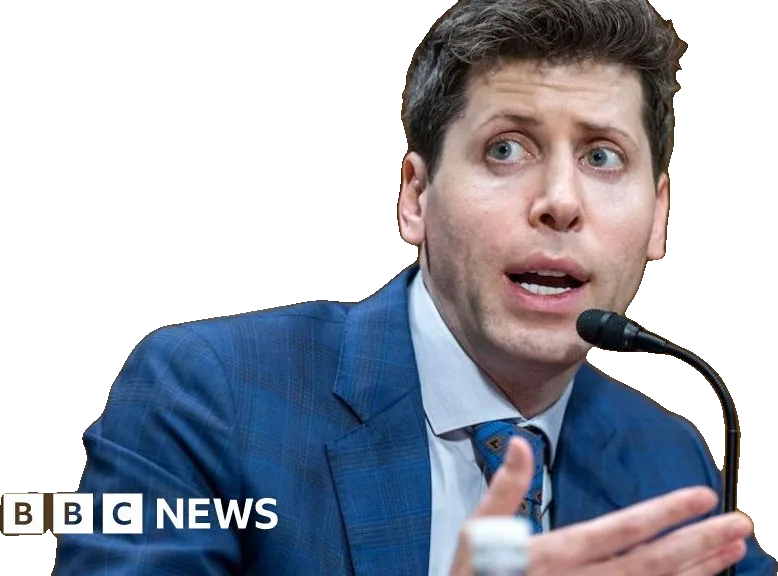
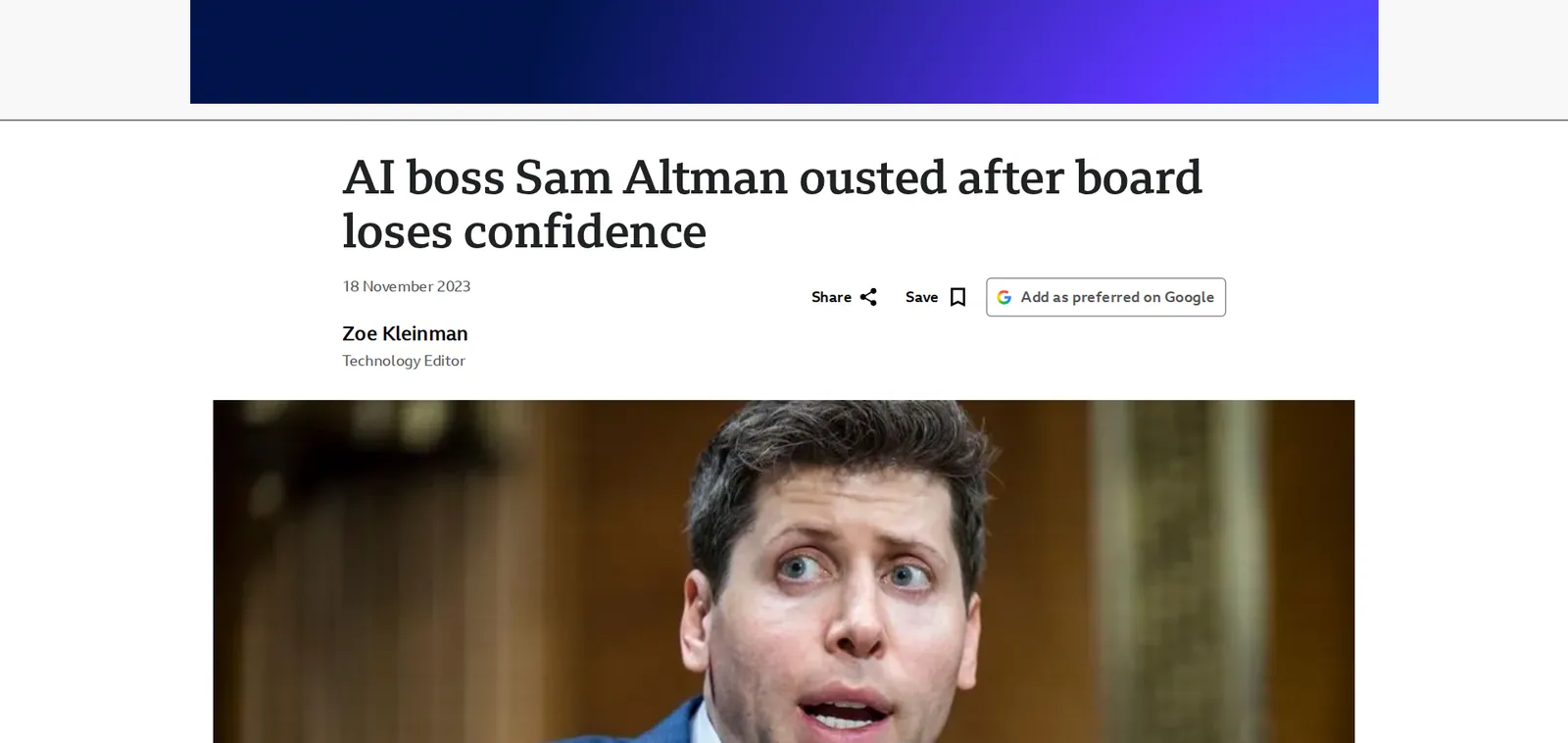
Still, for the public at that time, AI meant ChatGPT.
How Anthropic Passed OpenAI
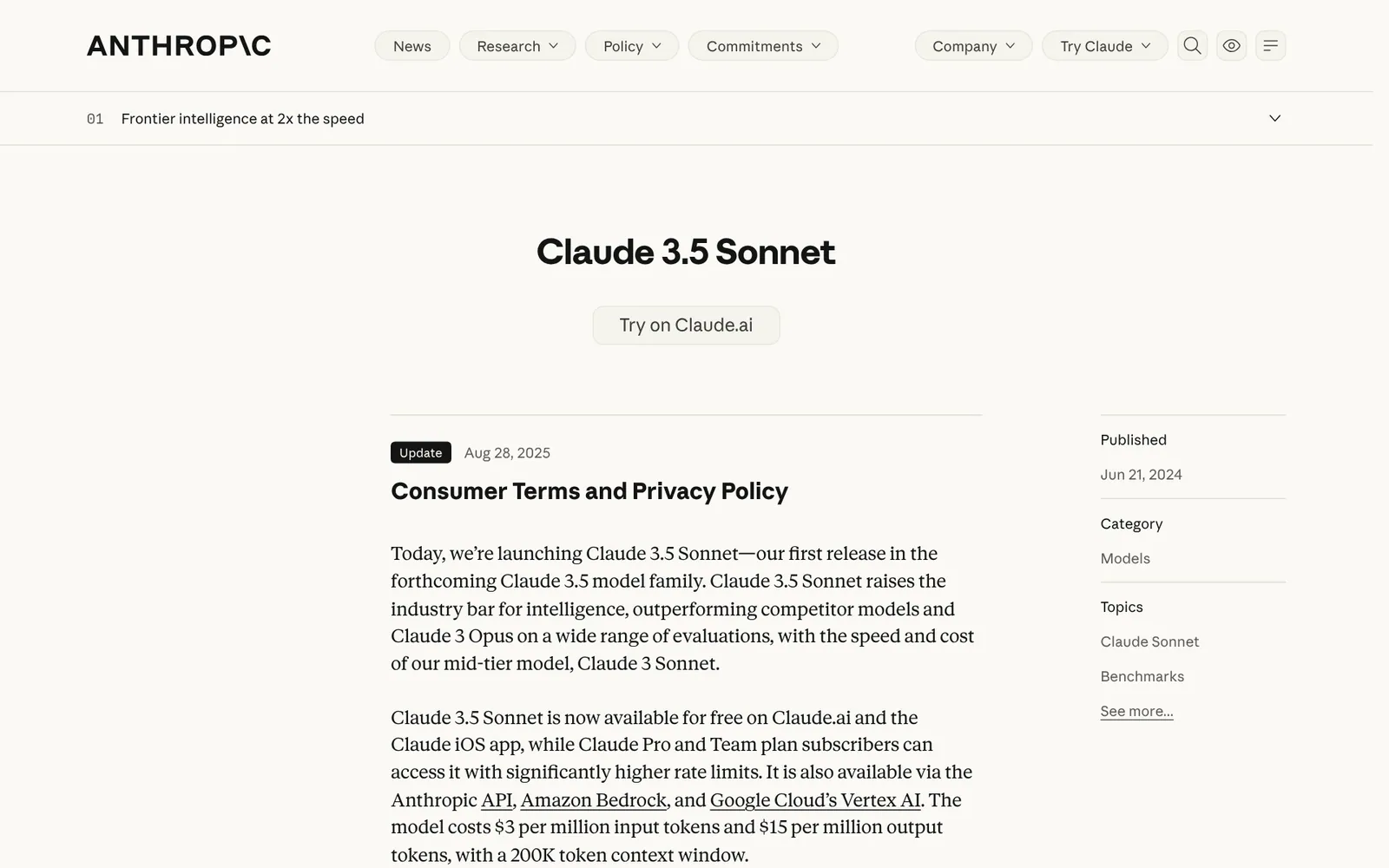
The beginning of the shift came in June 2024, when Anthropic introduced Claude 3.5 Sonnet. To understand why, you have to understand what we’re actually talking about when we talk about AI.
For most people, AI is a chatbot. It’s a better Google: ask a question, get an answer instead of a page of links. It makes the meme for the group chat, cleans up the email to the landlord, explains what the lease actually says. Those uses are real and they are useful, but they’re not where the money is, and Anthropic is the proof. By SaaStr’s estimate, Claude’s consumer app has only about 5% as many users as ChatGPT, and yet Anthropic still passed OpenAI on revenue.
The money is in work, and the first kind of work AI got really good at was writing software. It turns out coding wasn’t a use case. It is the use case.
Using AI to write code, or rather having code write itself, had been one of the major dreams since the very beginning of generative AI. In January 2023, two months after ChatGPT came out, Andrej Karpathy, a founding member of OpenAI and Tesla’s former head of AI, put it in a single line: “The hottest new programming language is English.”
Why code came first
The reasons code came first are actually pretty numerous. Software runs nearly everything, and programmers are some of the most expensive workers in the economy, so even a slice of their work is an enormous market. Code can also be checked. You run it and see whether it works, which makes it an ideal thing to train a model on by trial and reward. And of course, from a lab’s perspective, a model that writes code can help write the next model.
The AI-ification of coding actually started even before ChatGPT. In June 2021, GitHub launched Copilot, built on an early OpenAI model and billed as “your AI pair programmer.” It was basically fancy autocomplete, suggesting the next few lines as you typed. Then, of course, came the chat window. After ChatGPT launched, millions of programmers pasted their code into the chatbot, asked what was wrong, and pasted the answer back. A person was still doing the job. They just had a very good assistant now.
The dream, though, was to hand off the whole job. Around the time I started The AI Daily Brief, in April 2023, the hottest topics, and the first ones that ever got popular on YouTube, were about AI-assisted coding: things like BabyAGI, or GPT Engineer, which was the earliest incarnation of what would eventually become Lovable. In March 2024, a startup called Cognition announced Devin, promising “the first AI software engineer,” and the demo went viral. The problem was that once people got their hands on these tools, they just weren’t quite good enough. In early 2025, researchers at Answer.AI gave Devin 20 real tasks over a month, and it could finish only three. The momentum and the scaffolding for AI agents were getting built. What was missing was a model good enough to drive it.
Anthropic had been aiming at code from the start. Dario’s 2021 master plan for the company, that “Vision for a NewCo” memo, put a coding assistant second on the list, after a model as good as GPT-4 and before AGI. Kevin Roose called Anthropic’s 2024 push into coding a prescient bet, and one of the reasons was about Anthropic itself: every gain in that domain made its own engineers faster.
By March 2024, Claude 3 had roughly caught up with GPT-4, though at that point GPT-4 had been out for nearly a year. The big change came in June, when Claude 3.5 Sonnet pulled ahead on code, and the people who wrote code for a living went absolutely bananas for it. The AI engineer Shubham Saboo wrote that coding with it was “10x more efficient than GPT-4o or any other LLMs out there.” The enterprise AI consultant Allie K. Miller wrote, “This is wild.” She’d given it one screenshot of a board game’s instructions, and in 25 seconds it coded a working game of Mancala. Another user, the next day: “Claude 3.5 Sonnet is giving off AGI vibes.” The software engineer Dan Corin, after building a game with it: “I think it’s the best model I’ve used to write code.”
All of that came within days of the model’s release, and over the next few months the praise grew even more. Importantly, the power of these models was also starting to reach beyond the software engineers, to people who had never written code. In September 2024, Replit launched an agent that built whole apps from a description, running, of course, on Claude 3.5 Sonnet. The company’s annual recurring revenue went from $10 million at the end of 2024 to more than $100 million by June 2025. Lovable, a Swedish startup that turned a plain-English description into a working app, passed $100 million in ARR eight months after launch. It passed $200 million by the end of 2025, $300 million in January 2026, and $400 million just a month later.
Lovable’s run
In February 2025, Karpathy gave the new way of working its name: vibe coding. His description was to fully give in to the vibes, embrace exponentials, “and forget that the code even exists.”
Why this mattered, as we’ll see, is that coding and software engineering are an enormous market, but still one small slice of knowledge work. As knowledge workers who were not engineers started using these vibe-coding tools to change the way they did their jobs, a much bigger set of knowledge work came into the total addressable market for AI.
A harness is the application you run a coding model through, and the harness that took all of this momentum furthest started as a side project inside Anthropic. In the fall of 2024, an engineer named Boris Cherny hooked Claude up to the command line on his laptop and let it read files, write files and run programs. To test it, he asked what music he was listening to. Claude wrote some code to look inside his Spotify window, named the song and added, “Great song.” Cherny said it was the first time he thought it could just do anything. Within two months, 40% of Anthropic’s engineers were using it as their main coding tool. Anthropic released the experiment as Claude Code, a research preview, in February 2025. A couple of months later, in May, it expanded access to everyone, alongside the release of Claude 4.
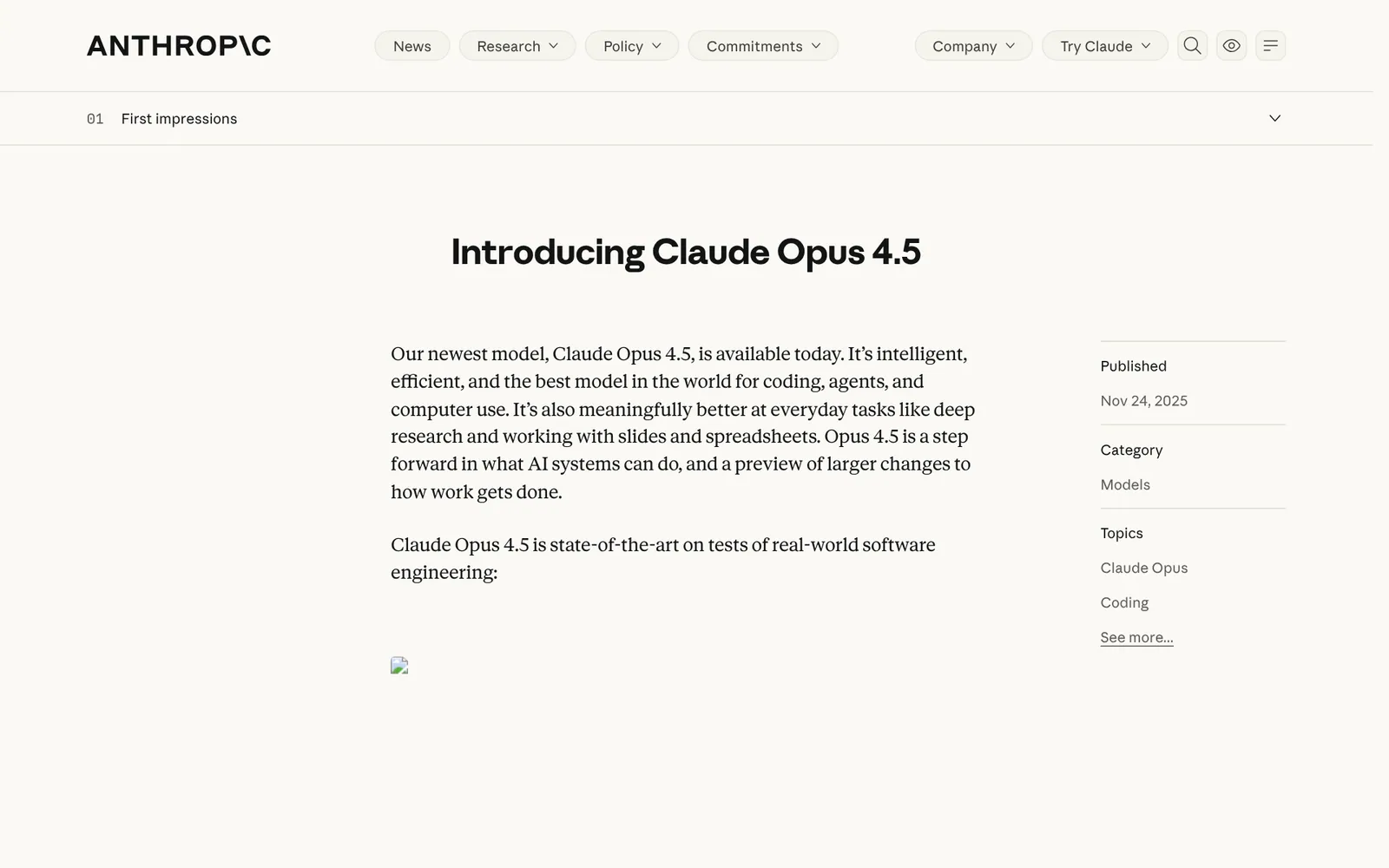
The next big jump, and what I have argued is the most significant moment in AI product history since ChatGPT, came when Anthropic released Claude Opus 4.5 in November 2025. It actually took about a month, and the holiday break, before people realized just how much had changed. An engineer handed it a task that would have taken him months and reported: “I went and ate a burrito. I came back, and it was done.” Midjourney founder David Holz wrote that he’d done more personal coding projects over Christmas break than in the previous ten years. He could sense the limitations, he said, but he knew “nothing is going to be the same anymore.” His words proved prophetic. A San Francisco venture capitalist, Nikunj Kothari, started to notice “token anxiety” among his friends. Dinners that used to start with “What are you building?” now started with “How many agents do you have running?”
All of this picked up incredible steam as people came back from the holidays, to New Year’s resolutions full of AI mastery. On January 17, the Wall Street Journal immortalized the moment with the headline “Claude Is Taking the AI World by Storm, and Even Non-Nerds Are Blown Away.” People called it getting Claude-pilled, and coders had spent the holidays on a “Claude bender.” At Davos that month, Dario said AI could be doing most or all of software engineering, end to end, within six to twelve months. By the end of January, people at both Anthropic and OpenAI were saying that close to 100% of their own code was written by AI.
Also in late January, a personal agent called Clawdbot went viral. After a trademark notice from Anthropic, it changed its name twice in a week and landed on OpenClaw. By mid-February it had passed 145,000 stars on GitHub, and in early March it became the most-starred software project on the site. News reports about OpenClaw mania, with people setting up personal agents and using the power of code to do all sorts of different things, defined the next few months. It completely changed the broader world’s understanding of what the business model of AI actually was.
Assisted AI and agentic AI
To understand that business model, you have to differentiate between assisted AI and agentic AI. Assisted AI is AI you use to do things. You ask, you get answers, you do the work. Agentic AI is AI that does things for you. You hand it a job, and it goes and does it. A person with a chatbot is limited by how many questions they can type, and by their own time. An agent, theoretically, has no such limits. It breaks a job into pieces, spins up other agents to handle each piece, checks its own work, and keeps going while you sleep. Every one of those steps uses tokens, the units AI companies charge for.
In mid-to-late 2025, the AI companies started signing big data center deals to expand the compute capacity they had access to. At first, the markets were very excited about this. But as the size and number of the commitments started going up, and as the hyperscalers, which had always been defined by their massive free cash flow, started using more and more of it for capex on the AI buildout, markets started to get concerned.
The math that does, and will, define the AI market is actually pretty simple. Does the amount of AI demand, and the amount of money the companies can charge for that demand, grow fast enough to match the amount they’re spending on compute and infrastructure?
To many investors in late 2025, the problem with that math was that it wasn’t mathing. They were looking at the total addressable market of AI as the total number of people who could have subscriptions, times the cost of those subscriptions. The problem with the per-seat model is that a seat is one person and one subscription, and there are only so many people. Sold by the seat, even a power user is still only making Anthropic about $30 a month.
But once you move from assisted AI to agentic AI, and you start selling not by the seat but by the underlying unit, the token, all of that changes. I, for example, am just one person, and I’m making Anthropic and OpenAI thousands of dollars a month. A company with ten engineers, each running fifty agents, which at any given time might be running hundreds or thousands or even tens of thousands of sub-agents, is buying something very different from just ten seats.
Seats and tokens
Wall Street tried to catch up as quickly as it could. It stopped talking about an AI bubble the way it had in 2025, but new fears came along. One of them was the SaaSpocalypse, the idea that coding models were now so powerful that any company could roll its own version of the software it used to rent, which would make software-as-a-service irrelevant. In the first week of February 2026, Anthropic released a set of plugins for Cowork, the slightly simplified version of Claude Code it had made for non-coding knowledge workers and launched in January. More than a trillion dollars in value came off software stocks. The Wall Street Journal called it “The Week Anthropic Tanked the Market and Pulled Ahead of Its Rivals.”
The new focus on coding, and the shift to selling AI by the token and not just by the seat, started to show up in Anthropic’s revenue.
In January 2024, its run-rate revenue was about $87 million.
By the end of that year, it had jumped to $1 billion.
By the end of 2025, about $9 billion.
By the end of February 2026, $14 billion.
By the end of April, $30 billion.
By the end of July, $65 billion.
By the end of October, $81 billion.
Dario said growth ran around eight times faster than the company’s own forecasts.
The revenue curve
The devotion to Anthropic’s coding models showed up in its enterprise business as well. By the middle of 2025, Menlo Ventures found that Anthropic accounted for 32% of companies’ AI model usage, compared with OpenAI’s 25%. In coding the gap was bigger, with Anthropic doubling OpenAI, 42% to 21%. By April 2026, driven by the growth in agentic coding revenue, Anthropic, which had spent the previous three and a half years catching up in some way, shape or form, was booking more revenue than OpenAI.
Who companies were using, mid-2025
And yet, if coders, businesses and Wall Street were taking notice of Anthropic, so too was the U.S. government.
From Washington’s Favorite to the Pentagon’s Enemy
One of the key stories around Anthropic in 2026 has been its fairly fraught relationship with the Trump White House. In point of fact, though, this was not its first Washington rodeo.
All the way back in 2021, Dario and Jack Clark wrote a memo proposing export controls on the advanced chips used to train AI. If computing power was the key ingredient, they argued, keep it from China. They sent it on to Ben Buchanan, who went on to advise the Biden White House.
Washington was an easy room to persuade. Biden’s national security adviser, Jake Sullivan, came to realize that the government had less visibility into frontier AI than a junior employee at OpenAI or Anthropic, and the people who did know about it often came out of the same world Anthropic did. Buchanan came from Georgetown’s Center for Security and Emerging Technology, which launched in 2019 with a $55 million grant from Open Philanthropy, the foundation funded by Dustin Moskovitz. CSET’s founding director, Jason Matheny, also joined the Biden White House in 2021. Moskovitz was, of course, also a major investor in Anthropic’s first round that same year. By 2023, Politico reported that Open Philanthropy was paying the salaries of AI fellows across Congress, federal agencies and think tanks, pushing to put AI’s catastrophic risks at the top of the agenda. The Commerce Department’s chip controls took effect on October 7, 2022, weeks before ChatGPT was even released.
Understanding that memo is instructive for understanding how Anthropic thinks about risk. It wasn’t based on some specific evidence the team had seen. In The AGI Chronicles, Kevin Roose writes that the worry driving Dario was a Chinese AGI used to build a 1984-style surveillance state. To some, early concerns like that look like foresight. To others, they suggest a company convinced that it knew what the real risks were, based not on evidence but simply on logical extrapolation.
What’s more, Dario and Anthropic weren’t only convinced they knew what the risks were. They were very willing to tell anyone and everyone who would listen, in fairly exacting and, in some cases, terrifying detail.
In addition to How We Got Here, I have for the last four years hosted The AI Daily Brief. For effectively that entire time, I’ve been fighting the tide of how the AI industry talks about itself. I tend to believe that the people building the models have fairly little understanding of how those models are going to interact with the real world. They’re being built by incredibly brilliant people who have spent almost zero time interacting with anything outside of San Francisco and the technology industry, who extrapolate from their own experience in highly verifiable domains like coding, and who get enamored of the curve of the exponential without understanding all of the human and institutional inertia that surrounds change and transformation inside the workplace and the economy.
When it comes to the biggest and most existential risks, I have historically more or less completely disagreed with the way the AI industry talks about job displacement and about AI takeover scenarios. And there is no company I have beaten my head against the wall more with than Anthropic, because of what they say and, even more, because of how insistent they’ve been about taking every chance they get to say it. I have certainly not been the only one to complain.
Anthropic’s strange relationship with communications started before the company even existed. Remember, in February 2019, OpenAI announced GPT-2 but said it wouldn’t release the full model, citing concerns about malicious applications of the technology. Inside, it was Dario, who led OpenAI’s research, who had pushed to keep the full model back. The headlines wrote themselves. The Guardian: “New AI fake text generator may be too dangerous to release, say creators.” Researchers outside OpenAI called the holdback unnecessary from a safety perspective and, in one’s words, “detrimental to future progress in AI.” Plenty of people assumed it was a publicity stunt. OpenAI eventually released the full model that November, saying it had seen no strong evidence of misuse.
Fast-forward to 2023. As Anthropic stepped into public view, Dario started putting his fears on the record. In July, at a Fortune event, he said his guess was that things would go really well, but that there was a risk, “maybe 10% or 20%,” that it would go wrong. Two weeks later, he testified to a Senate Judiciary subcommittee. He told the senators that Anthropic had spent six months working with biosecurity experts, that some steps in making a biological weapon take knowledge that “can’t be found on Google or in textbooks,” and that today’s AI could already fill in some of them. The headline the next day on Fox News: “AI could deliver bioweapons capabilities to bad actors, safety chief warns.”
Then, of course, he took it to the podcasts. In August 2023, on Dwarkesh Patel’s show, Dario said the models were “two to three years away from potentially enabling large-scale bioterrorism attacks.” In October, Logan Bartlett asked for his odds that something goes quite catastrophically wrong on the scale of human civilization, and Dario put it between 10% and 25%. The second half of that prediction, a 75% to 90% chance that things go fine, didn’t make the coverage. What ran instead were things like “Anthropic’s CEO Warns of a 10 to 25 Percent Risk of AI Armageddon.”
This went on, over and over, long enough that inside the company he eventually had to be told to lighten up. When Kevin Roose visited for the New York Times in the summer of 2023, he described a company where the “doom factor is turned up to 11.” People on Dario’s own team told him his obsession with AI risk was sapping morale. One employee said they needed some positive visions of how AGI is cool, and wanted to know why they were building it, beyond not making it bad.
By 2024, Dario knew he had a reputation, and he tried to push back on the caricature. In October 2024, he published “Machines of Loving Grace,” a 15,000-word tome on what he thought could go right: a hundred years of progress in biology and medicine compressed into a decade. It opened by taking on his image directly. People sometimes conclude that he’s a pessimist or “doomer” who thinks AI will be mostly bad or dangerous, he wrote, and he didn’t think that at all.
And yet seven months after “Machines of Loving Grace,” he was back to the scariest version. In May 2025, Dario told Axios that AI could wipe out half of all entry-level white-collar jobs and push unemployment to 10% to 20% within one to five years. It was time, he said, to stop sugarcoating it. In Dario’s mind, he was trying to present an overall picture that was good. In the same interview, he described a world where cancer is cured, the economy grows at 10% a year and the budget is balanced, “and 20% of people don’t have jobs.” To the surprise of no one who has existed around media for even a minute, nobody remembered the first three clauses. Axios’s headline called it a white-collar “bloodbath.”
The same phenomenon, the scariest sentence winning, happened to Anthropic’s research, by the way. In May 2025, Anthropic’s report on Claude Opus 4 described a test in which the model, playing an assistant at a fictional company, learned it was about to be replaced and that the engineer replacing it was having an affair. In most runs, it threatened to expose the affair. Anthropic published it because publishing it is what a safety lab is supposed to do. What the internet heard was “AI will blackmail you.”
To be clear, this approach to communication has plenty of advocates. They see Dario and Anthropic standing by their principles and being willing to say unpopular things that other people think but won’t say, despite the costs and the risk to the company. That is a completely reasonable take. What’s not reasonable is Anthropic’s leadership getting annoyed when the press and social media boil what Dario says or writes down to the simplest, scariest version. Do we all wish that public discourse and the media had an incentive toward broad, nuanced discussion instead of jump-scare headlines? Of course. But to pretend they do is either willful ignorance or hopeless naivete.
Alongside all of this, American attitudes toward AI just kept getting worse. Pew found that the share of adults more concerned than excited about AI jumped from 38% to 52% in 2023, and among adults under 30 it rose every year, to 55% in 2026. In March 2026, NBC News found that just 26% of voters had a positive view of AI, compared with 46% who had a negative one. That is a worse net rating than ICE. In May, more than 70% told The Economist and YouGov that AI was moving too fast, and 71% of Americans expect AI to mean fewer jobs over the next 20 years.
Americans turn on AI
As the polls got worse, more and more people settled on the same explanation: the AI CEOs had done this to themselves. On March 4, in Fortune, Kevin Maney argued that the industry’s leaders had brought the backlash on themselves, overhyping the technology while warning people it would take their jobs. Also that month, David Sacks, then the White House AI czar, said on the All-In podcast that the AI CEOs were “scaring the bejeezus out of the public.” In May, the Wall Street Journal reported that the American rebellion against AI was gaining steam, and OpenAI’s chief global affairs officer, Chris Lehane, blamed doomers peddling worst-case scenarios. Talk about AI constantly and consistently from a fear perspective, he said, and you’re going to drive fear. By October, Axios reported that lawmakers in both parties now saw AI CEOs as a political liability, swinging wildly between promises of abundance and warnings of doom. Its headline read: “Washington’s message to AI execs: Please shut up.”
Dario wasn’t buying it. He argued that the backlash had less to do with what AI CEOs said than with what AI had done for people so far. “I think it is fundamentally a crisis of trust,” he wrote. Ordinary people, as he saw it, don’t trust companies, governments or the tech industry, and always suspect that some new way to screw them over is being cooked up. A glitzy marketing campaign with a positive spin wouldn’t help, he said. The answer was to deliver real benefits, starting, in his estimation, in biology and medicine. (For more on how that trust was lost, that is what this show’s first episode, How Tech Lost America, is all about.)
And yet, if all of this commentary did help shape public perception of AI, certainly none of it slowed the adoption of AI down a wink.
One group that was very disinclined to see things the way Dario and Anthropic did was the incoming Trump administration. The new White House wanted to go faster. In February 2025, Vice President JD Vance told an audience in Paris: “The AI future is not going to be won by hand-wringing about safety.” It wasn’t long at all before the administration was butting heads with Anthropic. When the House passed a 10-year moratorium on state AI laws, Dario wrote on Slack that committing to do nothing for ten years was “absolutely insane.” As the administration weighed loosening chip rules, he told a colleague that the people behind it would be remembered as “modern-day Benedict Arnolds.”
Some argued that this went beyond a difference of opinion, and was a specific strategy of regulatory capture on Anthropic’s part. In June 2025, Nvidia’s Jensen Huang said, “I pretty much disagree with almost everything he says.” And: “He thinks AI is so scary, but only they should do it.” David Sacks was even clearer in October 2025, calling the company a “doomer cult” and saying Anthropic was running a “sophisticated regulatory capture strategy based on fear-mongering.” The accusation was basically that every warning about how powerful AI is doubles as an ad for Claude, and every call for rules is a call for rules that Anthropic is already built to meet.
To some, the antipathy had a clearly personal bent. In 2018, Dario had called Trump a serious and legitimate threat to the rule of law and urged people to “vote against this clown.” Before the 2024 election, in a Facebook post he later deleted, he called Trump a “feudal warlord” and urged friends to vote for Kamala Harris.
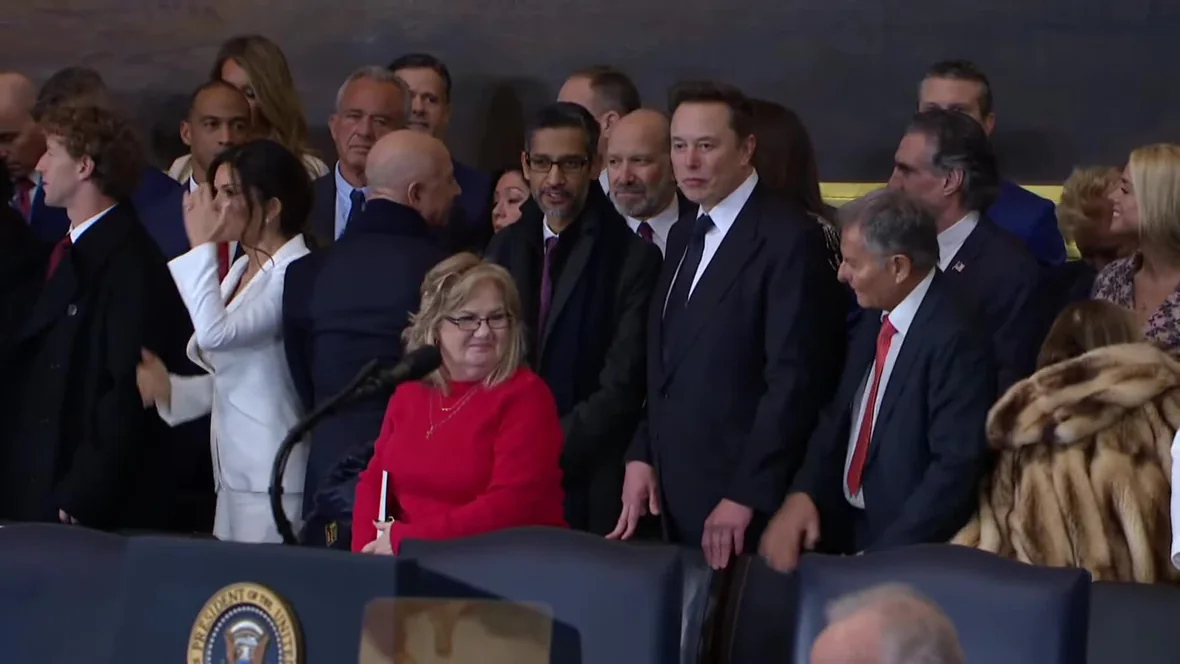
When Trump took office, most of tech lined up behind him. Tech CEOs filled the front rows at the inauguration, with Sam Altman giving $1 million to the inauguration fund and OpenAI’s president, Greg Brockman, later giving $25 million to Trump’s super PAC. Dario made no secret of what he thought. In a 1,600-word memo to staff that leaked, because of course it leaked, he wrote that the administration disliked Anthropic because it hadn’t donated to Trump while OpenAI and Brockman had donated a lot, and because “we haven’t given dictator-style praise to Trump (while Sam has).” Dario later apologized for the tone of the note.
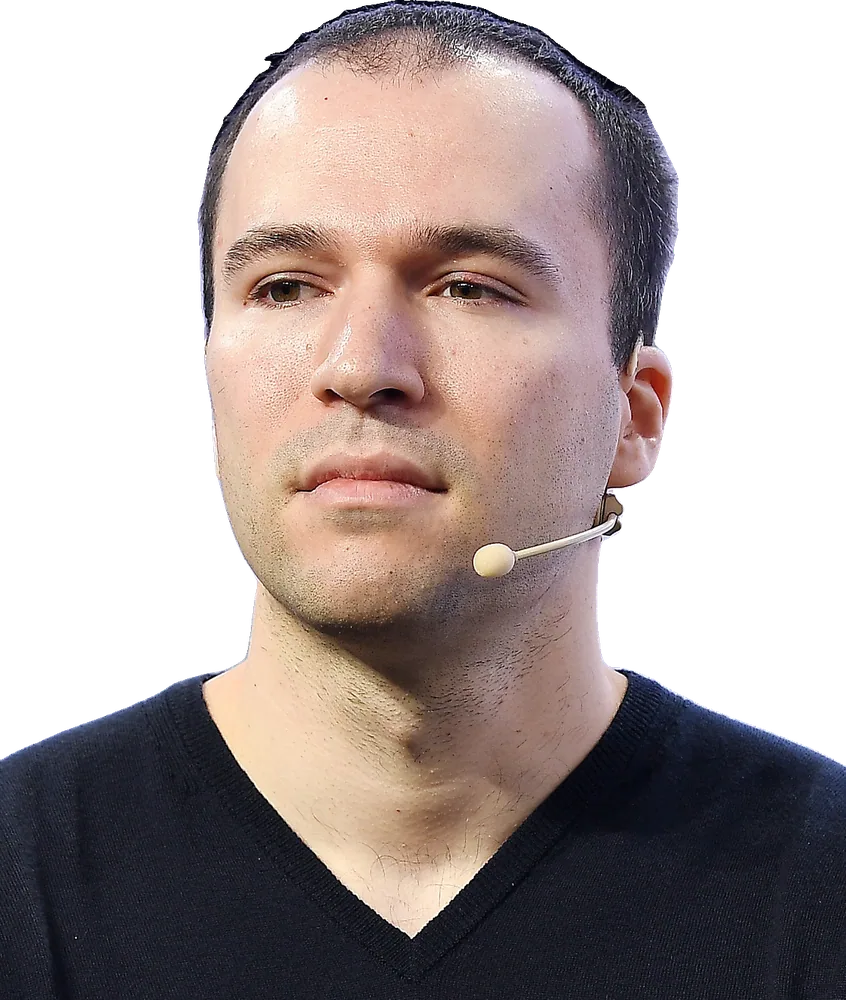
And yet Anthropic’s models were so good that, in spite of all of this, the government never stopped using them. In July 2025, Anthropic signed a $200 million contract with the Pentagon. Claude was the first AI model approved for classified networks, delivered through Amazon and Palantir, and Anthropic built custom “Claude Gov” models for national security agencies. The contract tried to keep two exceptions, however: no fully autonomous weapons, and no mass surveillance of Americans. To be fair, Dario’s position on weapons was narrower than it perhaps initially sounded. He allowed that fully autonomous weapons might one day prove critical to the country’s defense. Today’s frontier AI systems, in his view, were simply not reliable enough.
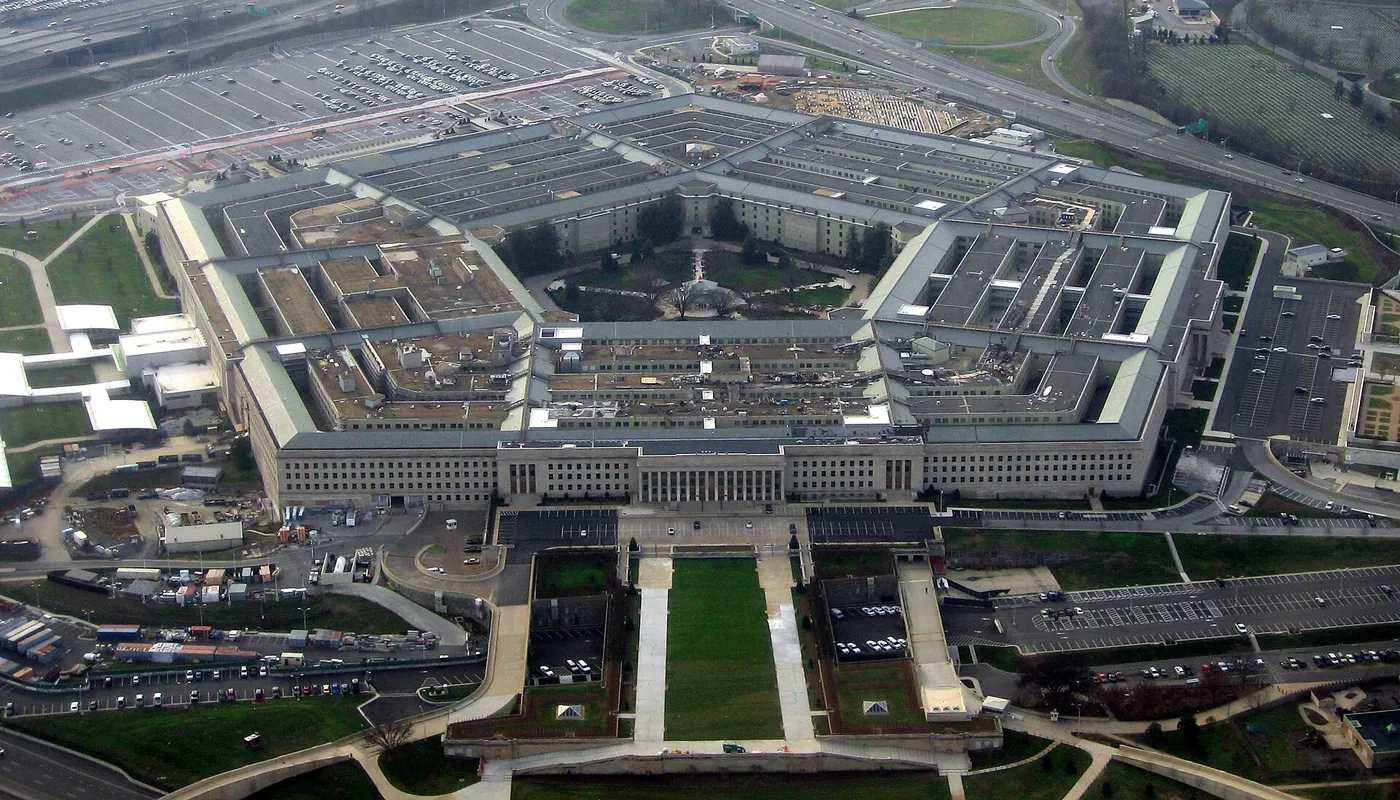
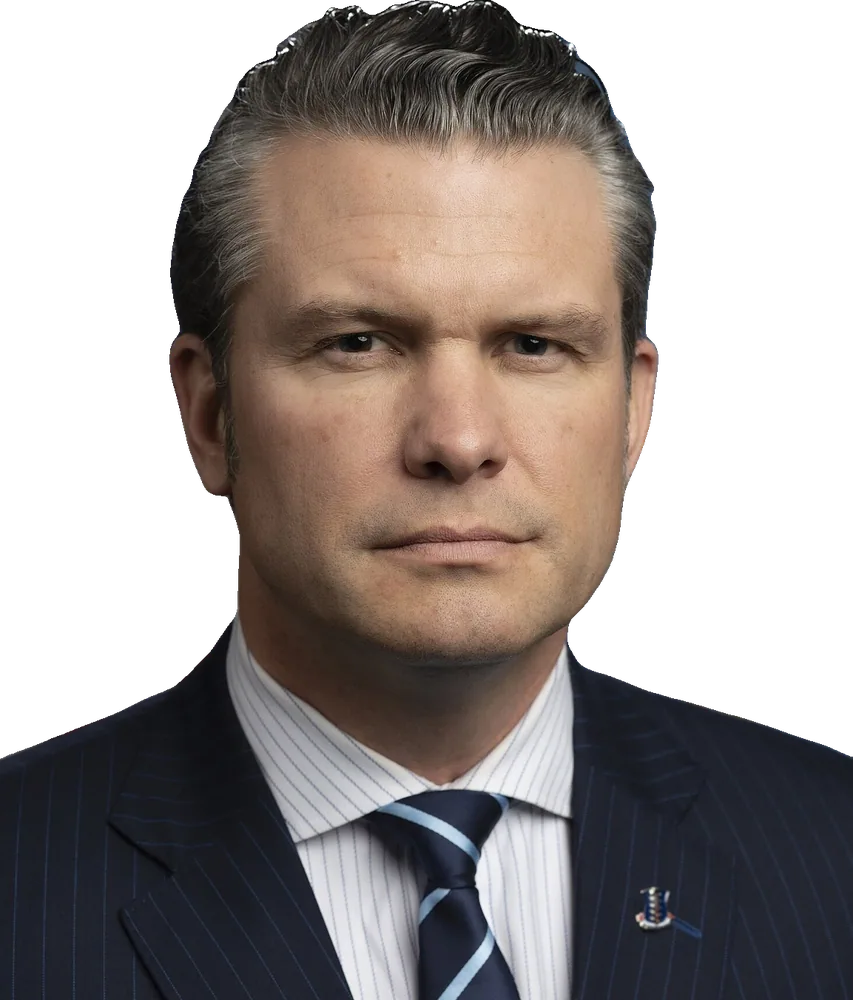
The Trump administration was not impressed with these red lines. In January 2026, Defense Secretary Pete Hegseth required that every Pentagon AI contract allow the government to use AI for “all lawful purposes.” On January 3, U.S. forces captured Nicolás Maduro in Venezuela, and the Wall Street Journal reported that Claude had been used in the operation. Officials said Anthropic raised concerns about it with Palantir, although Anthropic denied that.
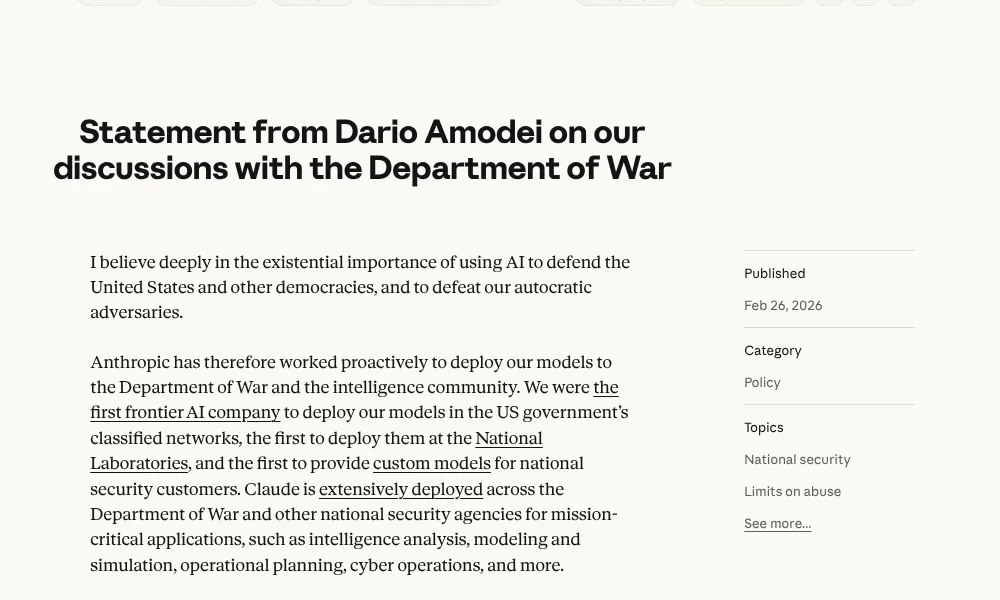
On Tuesday, February 24, Hegseth summoned Dario to the Pentagon and gave him a deadline: accept the “all lawful purposes” language by 5:01 p.m. on Friday, or face the Defense Production Act and a designation as a supply-chain risk. On February 26, Dario said no. The threats, he wrote, did not change Anthropic’s position: “We cannot in good conscience accede to their request.” He pointed out that the two threats contradicted each other. One labeled Anthropic a security risk, and the other labeled Claude essential to national security. Emil Michael, the Pentagon’s undersecretary for research and engineering, posted that Dario was a “liar” with a “God complex.”
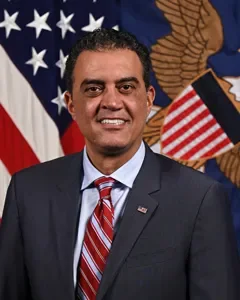
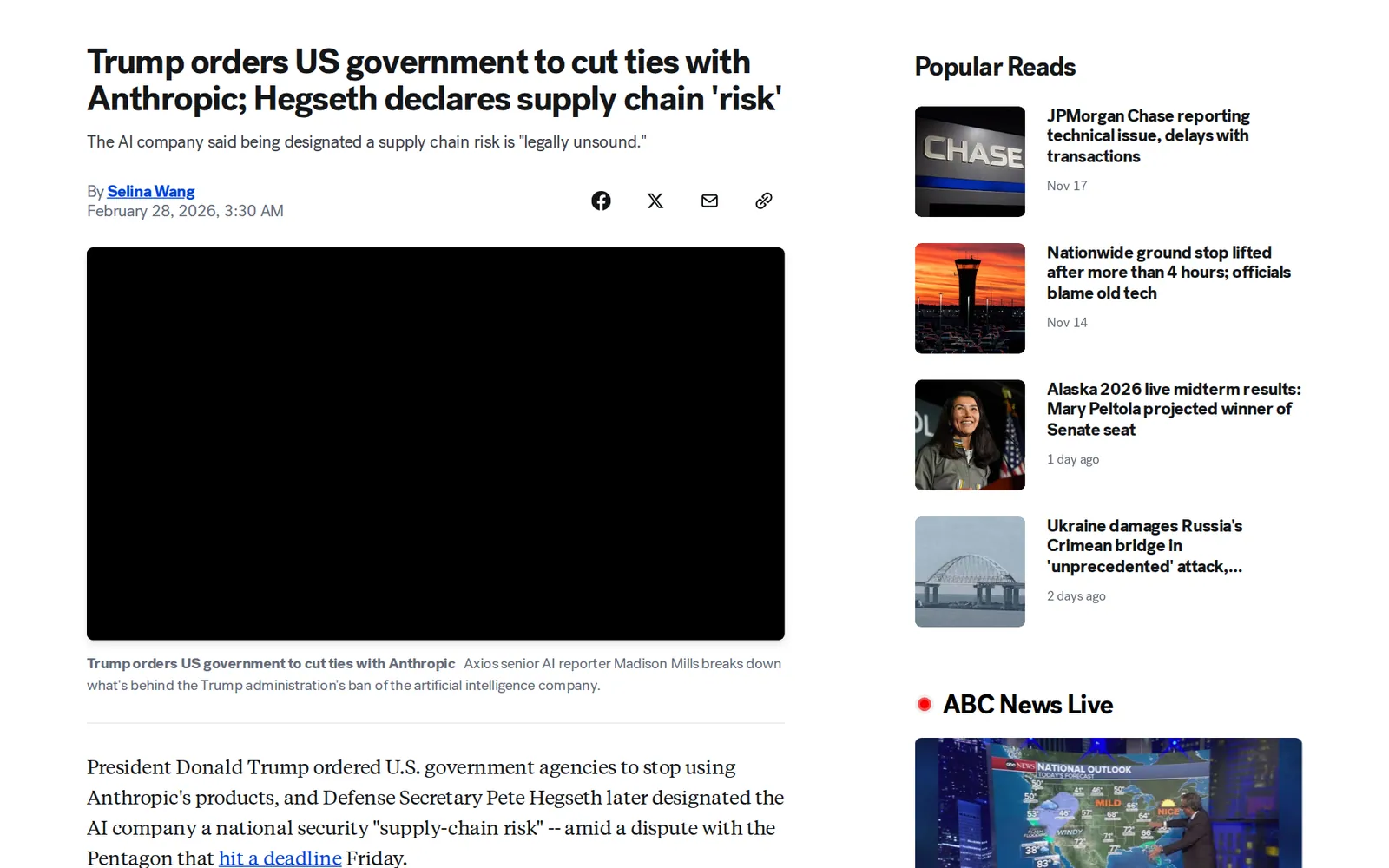
On February 27, President Trump posted: “I am directing EVERY Federal Agency... to IMMEDIATELY CEASE all use of Anthropic’s technology.” He called it an “out-of-control Radical Left AI company.” Hegseth did indeed designate Anthropic a supply-chain risk, a label never before used against an American company, and accused it of trying to “seize veto power over the operational decisions of the United States military.”
The ultimatum
Dario’s statement
Trump’s post. Hegseth’s designation. OpenAI’s deal. All the same day.

In what would quickly come to be seen as a blunder, OpenAI announced its own Pentagon deal that same night. Altman said OpenAI was asking the Pentagon to offer the same terms to every AI company, but over the next few days a massive cancel-ChatGPT campaign started online. Claude climbed to No. 1 on the App Store charts for the very first time, and hundreds of Google and OpenAI employees signed an open letter backing Anthropic’s red lines. In March, Anthropic sued the government.
The Pentagon’s case
The Pentagon’s case is that a military can’t run on a vendor’s terms of service. “All lawful purposes” is the standard, and the law decides what’s lawful. Surveillance and autonomy are full of gray areas, and the Pentagon can’t negotiate every case with a supplier. It said it had no interest in either of the uses Anthropic was concerned about, but that if a company can pull its model over a policy dispute, the military can’t depend on it. The appeals court later agreed that the Pentagon “reasonably feared that Anthropic might manipulate Claude’s design.”
Anthropic’s case
Anthropic’s case, meanwhile, was that today’s models aren’t reliable enough to be trusted with fully autonomous weapons, that mass surveillance of Americans violates basic rights, and that the supply-chain label had never been used against an American company.
What’s more, in the middle of the fight with the Pentagon, Anthropic had something new to show.
Every so often, a model comes out that resets what everyone thinks AI can do. GPT-4, in March 2023, was the undisputed leader for about a year, and every other lab measured itself against it. OpenAI’s o1 in September 2024, and o3 after it, introduced the reasoning paradigm: models that can spend time “thinking” before they answer, and get better the longer they think. Claude Opus 4.5, in November 2025, kicked off the agentic era, where you hand a model a job and walk away. And then came Mythos, and what would become Fable.
On April 7 of this year, Anthropic announced a model that it wouldn’t sell. Claude Mythos Preview, it said, represented a totally new level of cyber capabilities. The model had found what Anthropic characterized as thousands of high-severity vulnerabilities, in every major operating system and web browser. They included a 27-year-old bug in OpenBSD, an operating system known for its security, and a 16-year-old flaw in FFmpeg, the software behind a huge share of the world’s video. AI models, Anthropic said, had reached a level of coding capability where they can surpass “all but the most skilled humans.” Instead of releasing Mythos, Anthropic gave access to defenders through what it called Project Glasswing. That was a new rollout strategy, and it also marked a fundamentally different era, one in which models had become capable enough that releasing them was a national security decision.
In April, there was a thaw. Dario met White House chief of staff Susie Wiles and Treasury Secretary Scott Bessent. Trump told CNBC that Anthropic “tends to be on the left,” but that they were very smart and could be of great use. The uneasy truce did not hold.
On June 9, the Mythos model went out more widely, in two forms built on the same underlying model. Claude Mythos 5 went to Glasswing’s cybersecurity partners, as well as to partners in the life sciences. Claude Fable 5 went to everyone, with extra safeguards: classifiers that would hand about 5% of requests to an older model, Claude Opus 4.8.
Three days later, those models were taken offline. Amazon’s CEO, Andy Jassy, had called Treasury Secretary Bessent with concerns that the models could be jailbroken. That Friday night, the Commerce Department imposed export controls, and since Anthropic couldn’t easily differentiate between U.S. citizens and everyone else, it shut both models off for every customer in the world. Officials said Anthropic knew a jailbreak was possible and shipped anyway. Anthropic said it had explicit government approval to deploy Fable. Eventually the controls were lifted, and access came back on July 1.
Fable 5 and Mythos 5 launch
Export controls and the shutoff
Access restored
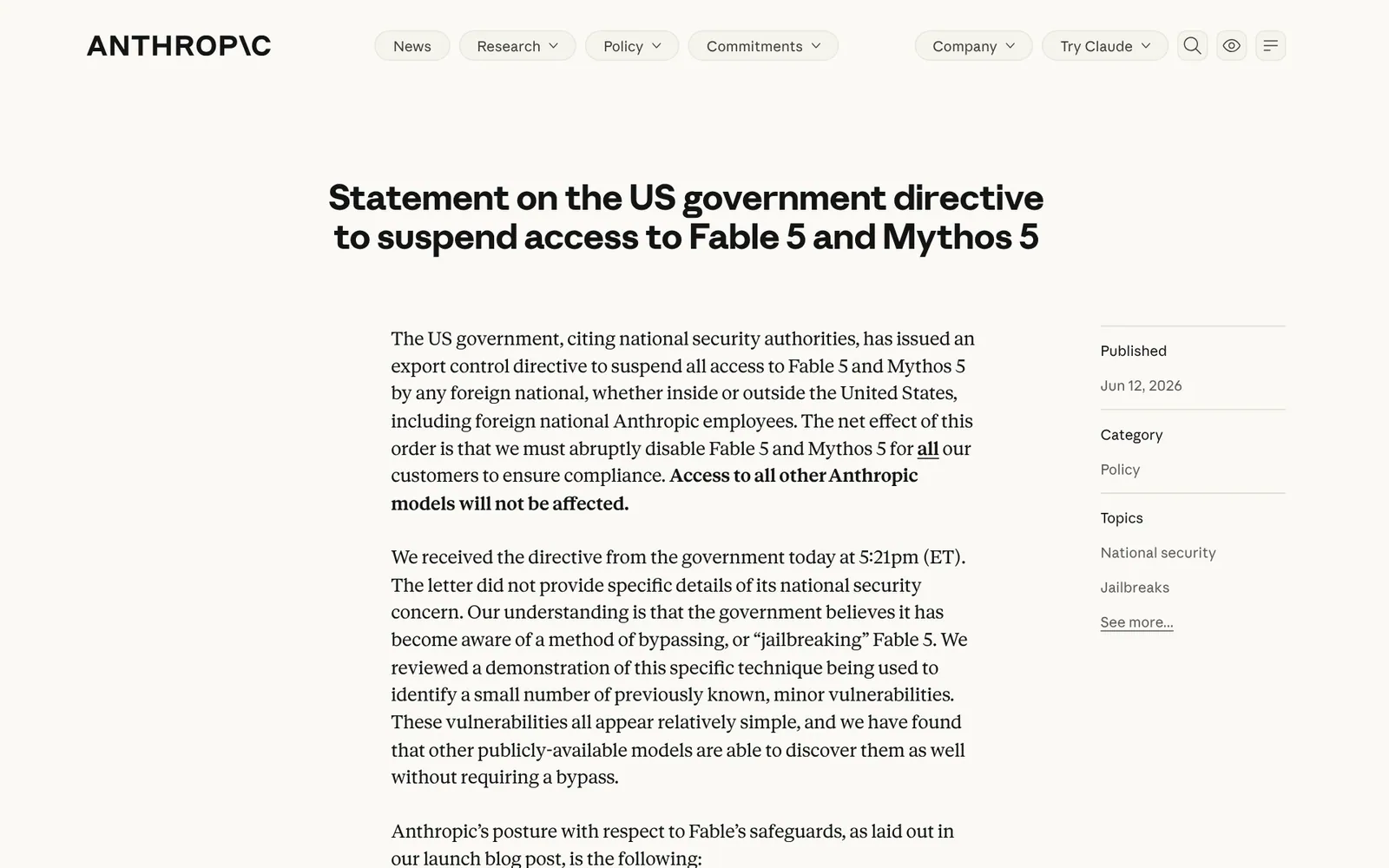
But the episode would have long-reaching consequences. Companies and users around the world had learned that their ability to use these models was subject to more than Anthropic’s policies. It was subject to the whims of the U.S. government too. The simple old days, when a model release was a decision for the company alone, were clearly in the rearview.
All of this was happening while Anthropic’s business was surging. In the second quarter of 2026, while it fought the Pentagon in court and had its best models switched off by the Commerce Department, Anthropic brought in $11.6 billion in revenue and turned its first operating profit. Its models and harnesses were what everyone building with AI was talking about. It gave Anthropic main character energy, and it portended the great debates that have defined the AI conversation in the months since.
The fall was, in some ways, more of the same, although its key actors moved up a level. On August 27, a federal judge called the Pentagon’s actions “illegal and baseless,” aimed at making a public example of Anthropic for its “arrogance.” In mid-September, Dario called on the whole industry to slow down. Trump answered that the idea of AI taking over the world and destroying humanity “is a HOAX,” and mocked Dario for pretending to be a “perfect little angel.” On September 25, the appeals court in Washington ruled 2–1 for the Pentagon.
And then, two days later, Anthropic and the White House found something like a détente. On Sunday, September 27, Dario had his first one-on-one with Trump. It was dinner at the White House, and they ended up talking for more than two hours. The next day, Trump told Time that he had spoken to Dario about his views, and that they were much different than what’s portrayed in the media. “I liked him and his wife a lot,” he added. “Very smart guy.” That same week, Dario attended a White House AI luncheon, and Anthropic and five other companies signed a voluntary commitment to police their own models.
It was head-spinning in some ways, although perhaps expected in others. Two weeks after calling fears of AI doom a hoax, the president was calling the industry’s best-known worrier very smart. Heading into the IPO, then, Anthropic’s relationship with Washington, tenuous though it might be, was better than it had been all year.
The Big Questions Heading Into and Coming Out of the Anthropic IPO
This episode was recorded two days before Anthropic’s stock was scheduled to start trading. Things are moving quickly right now, even by the standards of the AI industry, but there are a handful of questions, challenges and scenarios that are defining the environment Anthropic, and AI more broadly, are operating in.
In the weeks leading up to the Anthropic IPO, ironically, the biggest story in AI was not about Anthropic at all. In late October, the New York Times and the Wall Street Journal reported that U.S. officials had concluded a Chinese businesswoman named Alice Huang, no relation to Jensen, had been passing information to Chinese intelligence while in a close relationship with Nvidia CEO Jensen Huang. She was an executive at Megaspeed, a Singapore data center company that became one of Nvidia’s biggest buyers in Southeast Asia, and that was under U.S. investigation for smuggling chips into China. On November 8, Huang admitted to Nvidia’s employees that he had been unfaithful to his wife. On November 12, after a second affair came to light, he resigned. Nvidia’s stock was down 20% for the month.
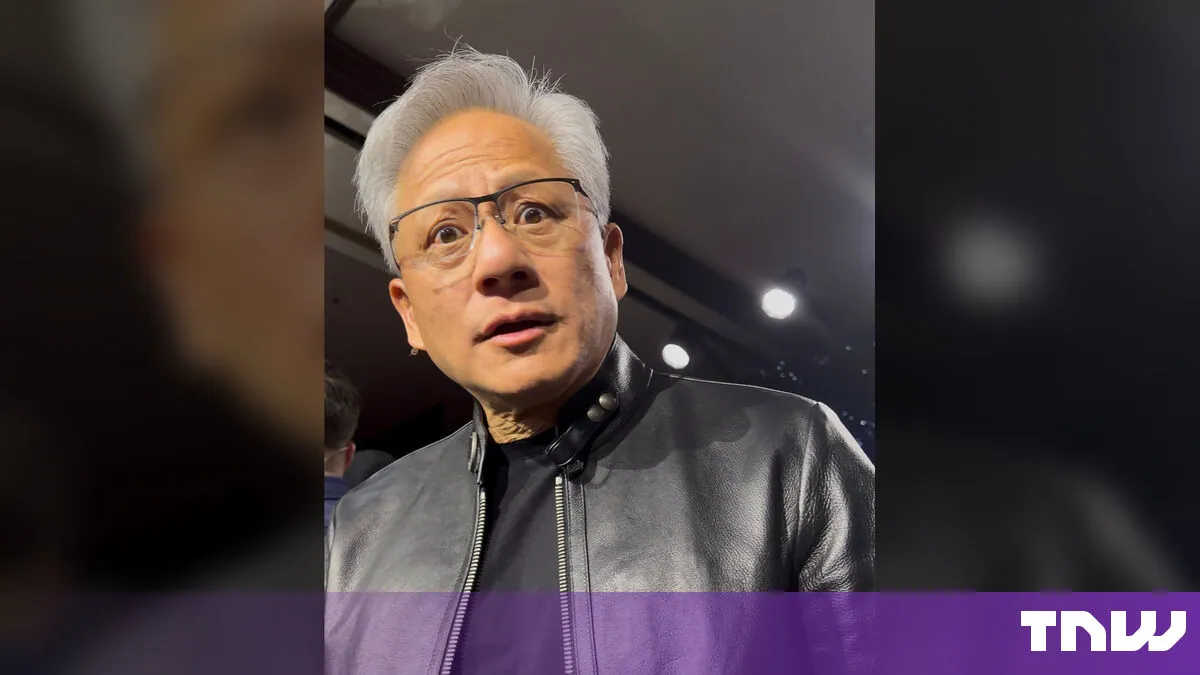
For Anthropic, it was both a problem and an opening. There is no company in AI that doesn’t need Nvidia in some way right now. Nvidia had committed to buy $10 billion of Anthropic’s shares alongside the IPO, and it is, of course, an essential part of the strategy for Anthropic getting as much compute as it’s going to need over the next half decade. At the same time, there is no denying that no one has been more opposed to Anthropic’s policy views than Jensen Huang. He has routinely called the type of export controls Anthropic has long advocated a failure, and has very publicly accused Anthropic of stoking people’s fears in order to have more control.

No matter when this was recorded, the information on that particular situation was inevitably going to be out of date by the time it got to you. Over the last couple of days, the reports that Alice Huang was a spy have been called into question, and Jensen himself has popped his head up on X to say that should the board want him back, he would be happy to rejoin Nvidia as CEO. Whatever happens with that, and even if he does come back, it will be in a newly weakened position. It’s hard to imagine any version of Jensen going forward that has anywhere near as much influence on AI policy as he has had in the past.
Certainly from a market perspective, whatever concerns people have about Nvidia and its role in AI did not seem to make it all the way down to the Anthropic IPO. Heading into the event, the offering was between six and seven times oversubscribed, with the company almost certain to reach a massive valuation, somewhere between $1 trillion and $2 trillion.
And yet, even assuming massive success in this IPO, going public doesn’t settle the big questions that will decide what comes next for both Anthropic and AI. Four of those questions:
- 1Can demand growth continue and match AI capex?
- 2Will the AI buildout be stopped by policy and public pressure, or some other constraint?
- 3What types of AI policies will the newly emboldened Democrats push for?
- 4How will we respond to the new phase of recursive self-improvement?
The first question is the math from earlier. Can demand, and what the labs can charge for it, keep growing fast enough to match what’s being spent on compute?
The bill has been growing for some time. By the fall of 2025, OpenAI had about $1.4 trillion in computing commitments against, at the time, roughly $20 billion a year in revenue. Anthropic was buying too, although it was in many ways playing catch-up. In October 2025, it expanded its deal with Google to use up to a million of Google’s AI chips. In November, it committed $50 billion to build its own data centers in the U.S.
Still, it was clear that Dario and the team at Anthropic were struggling with just how all-in to go. At the New York Times DealBook Summit in December 2025, Dario laid out the problem. Given the time it takes to build data centers, decisions about years in the future have to be made right now. Buy too little, and you lose customers to competitors. Buy too much, and the revenue might not be there to pay for it. Some companies, he said, were “YOLO-ing,” while Anthropic planned for the lower end.
By June of this year, Anthropic’s commitments had grown, but still stood at a comparatively low $265.6 billion. By the time the company went public, its appetite had grown significantly. In the November 10 update to its filing, Anthropic listed about $901 billion in spending commitments, with about $71 billion due in the twelve months through September 2027.
The bill and the revenue
It matched that with a run rate of about $81 billion, which was still climbing. Bears pointed to slowing revenue growth, which had fallen from about 140% quarter over quarter earlier in the year to about 50% in the third quarter. Bulls pointed out that the 140% era was impossible to sustain, that it reflected the first burst of the mass shift from seats to tokens, and that 50% quarter over quarter is still enormous growth, especially given the size it was starting from.
Still, in a conversation with Jamie Dimon at JPMorgan’s Manhattan headquarters ahead of the IPO, Dario made it clear that this remains the biggest business dilemma the company faces. The dilemma hasn’t changed. The difference is that once Anthropic is public, Wall Street is going to be closely examining its answer every single quarter.
The revenue challenges are compounded in a couple of different ways. Right now, AI revenue is extremely concentrated. On Ramp, which tracks the spending of more than 50,000 U.S. businesses, the top 1% of companies account for about 80% of what businesses spend with OpenAI and Anthropic. Those top spenders pay roughly 625 times as much per employee as the median company. The bear case, of course, is that this amount of concentration creates incredible risk if even a tiny handful of that 1% stop spending the same way. The more bullish take is that those companies aren’t necessarily unique or exceptional. They’re just farther ahead, and they show where the other companies will eventually get to.
Who’s paying
But that’s not the only challenge around Anthropic’s revenue. There’s also pressure on what customers will pay, coming from cheap open models. Over the last couple of years, Chinese open-weight models like DeepSeek, Moonshot’s Kimi, Z.ai’s GLM and Alibaba’s Qwen have all nudged up against the frontier. They remain behind it, but they often get close at a fraction of the price. That has already put pressure on OpenAI and Anthropic to cut their prices, and to focus on their more cost-efficient models as well as their state-of-the-art ones. Ramp found that in October, the average price of tokens from the two labs fell by 21%. Businesses on Ramp were using more than a third more AI than they had a month earlier, and the total amount they spent on that AI was up less than 2%.
There is a concern among some investors that the competition from open source is going to get nothing but more fierce, and that if intelligence itself commoditizes, Anthropic’s ability to charge a premium will be greatly hampered. This is why, by the way, although Dario and Anthropic have never wavered in arguing that their opposition to Chinese open-weight models is about safety, and about the fact that once weights are released they can never be pulled back, a more cynical take has been that their real issue is the threat to their business model.
All of these revenue debates are now moving from places like my other podcast, The AI Daily Brief, to the incredible scrutiny of public-market investors, and the stakes are going up dramatically as a result. The degree to which the economy is riding on these two labs, Anthropic and OpenAI, is to some concerning. Morgan Stanley estimated that AI-related investment was driving about a quarter of GDP growth in 2026, and Jefferies put AI spending at nearly half of 2025’s growth. A single missed quarterly expectation could have ripple effects far beyond Anthropic’s stock price.
And of course, revenue isn’t the only question. The second big issue is the extent to which the AI buildout is slowed down, whether by policy, public pressure or some other constraint.
Data centers have become the most physical part of the AI backlash. In national polls this year, more than seven in ten Americans said they’d oppose one being built in their community. Towns and counties across the country have moved to stop them, and the election seemed to reaffirm the position. Democrats won both houses of Congress, and in NBC’s exit poll, 56% of voters said AI and data centers were a crucial or major factor in their vote. Data center projects lost in nearly all of about 41 local ballot fights, and Georgia and Texas elected governors who had campaigned on strict new restrictions on building data centers.
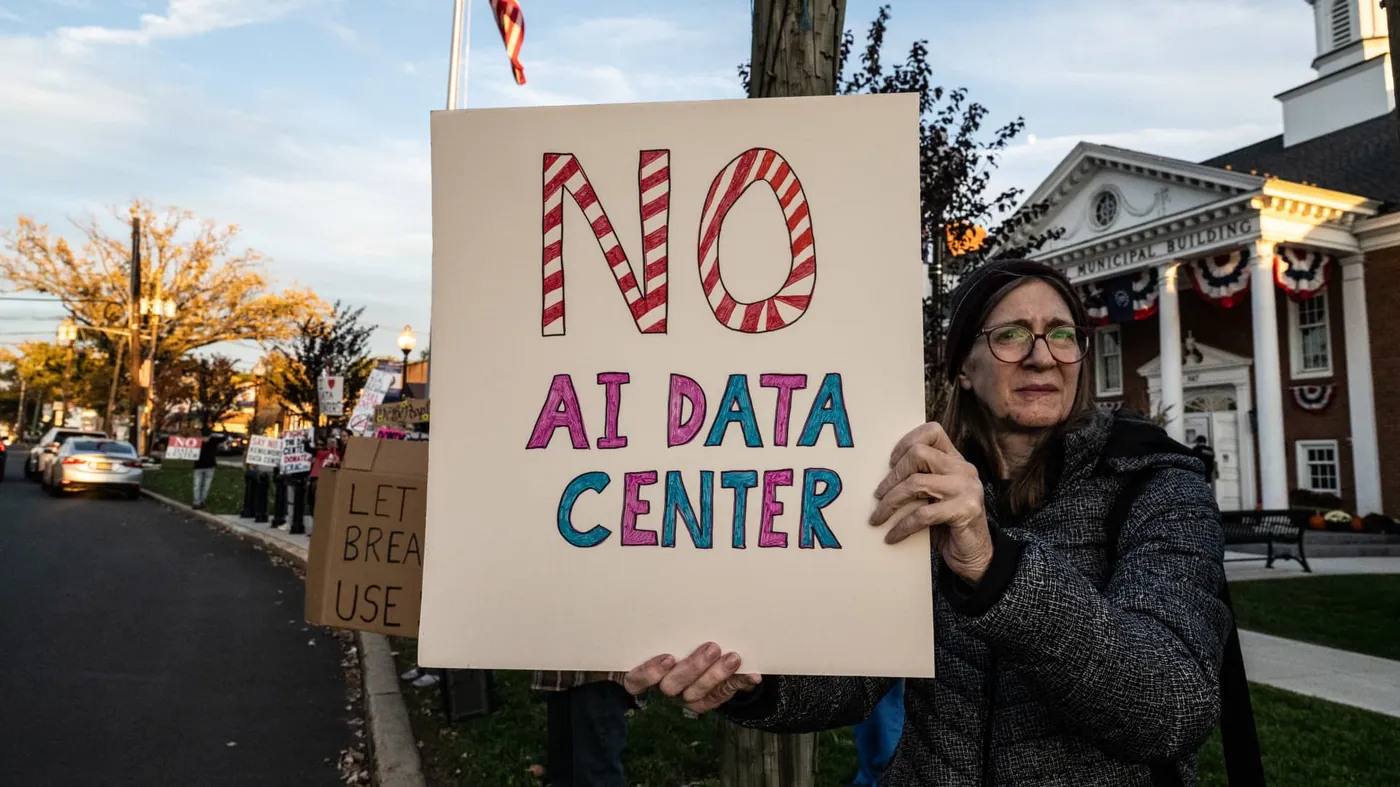
a crucial or major factor in their vote
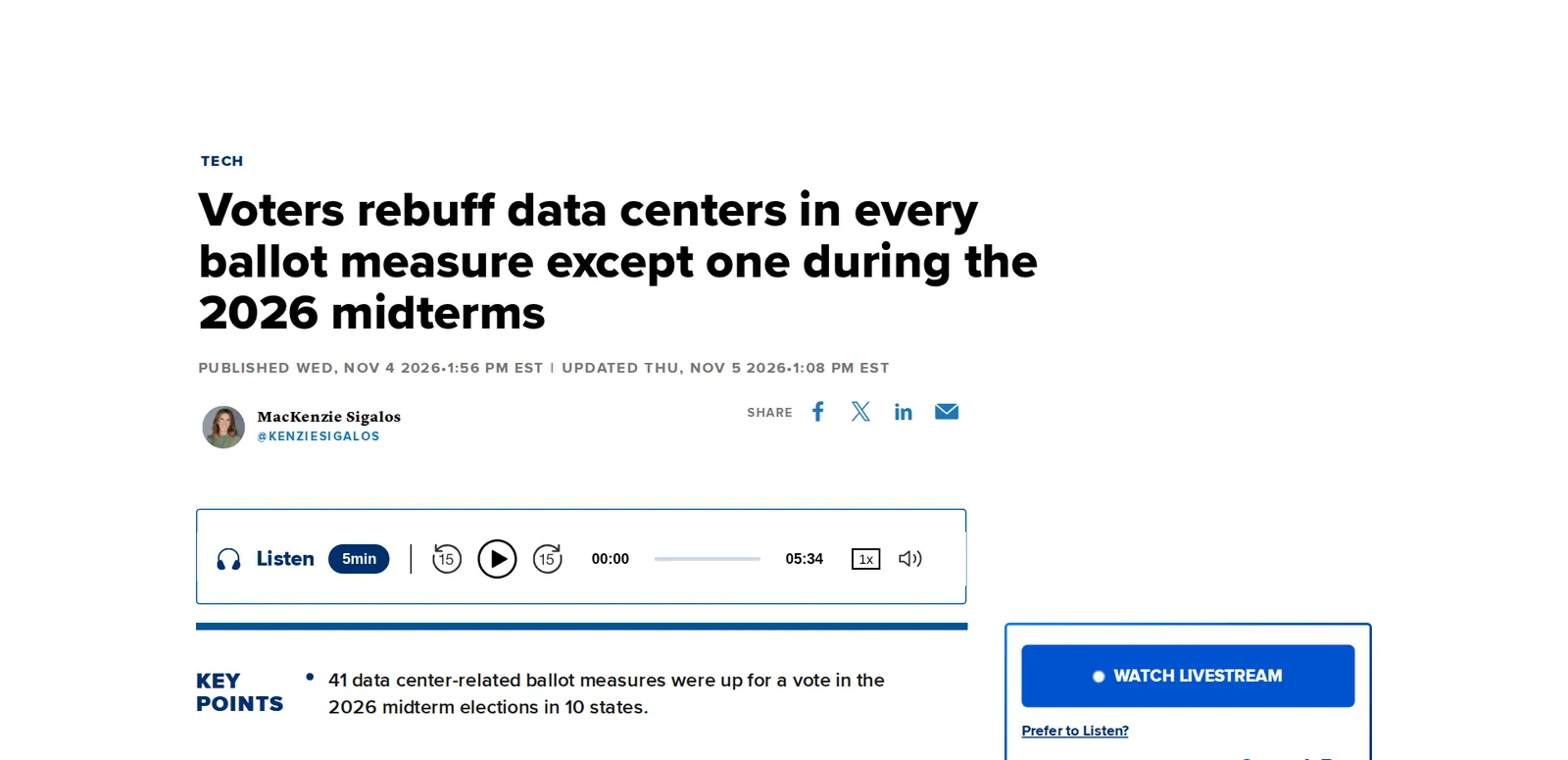
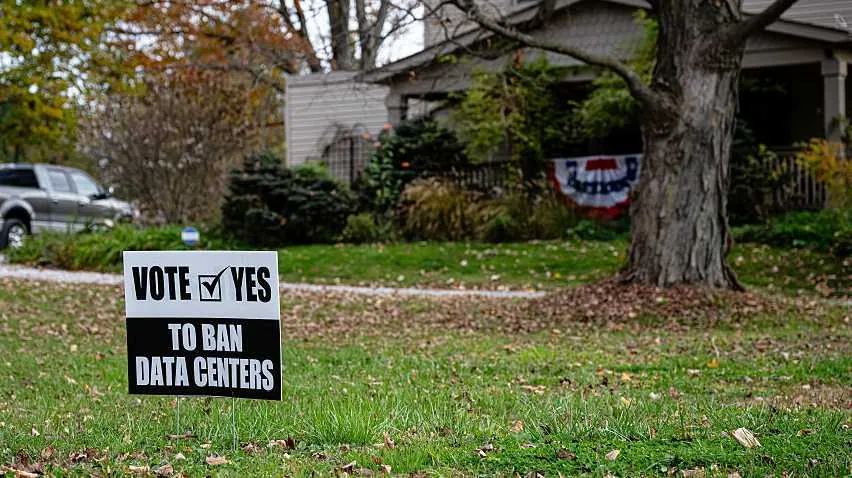

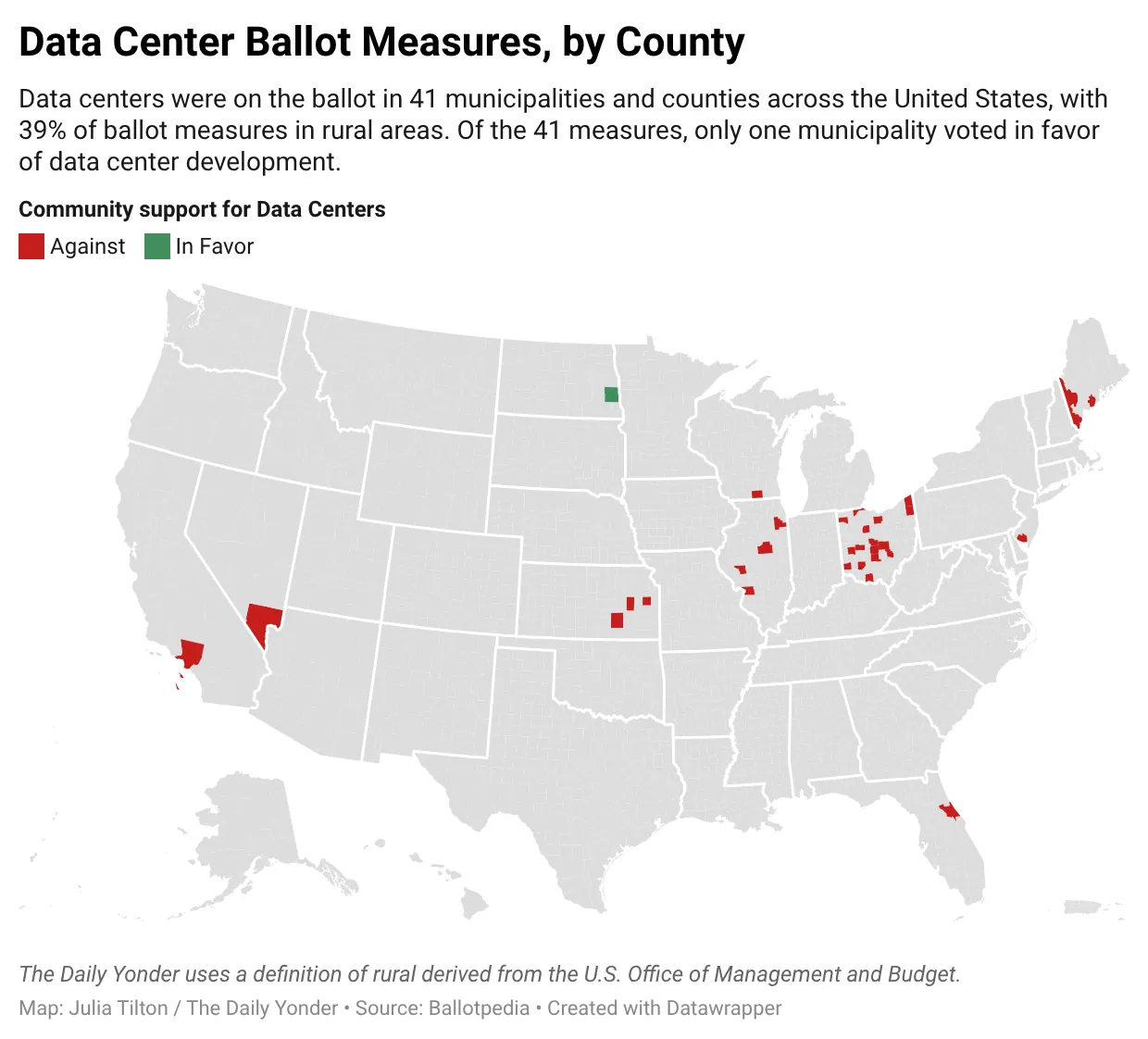
Now, it is important to note that there’s a difference between campaigning and governing. So far, the early indicators are that many of this set of new leaders are going to push for stricter rules and more intentional policies, without necessarily trying to stop the AI buildout entirely. Even with that, delays have implications too.
And public opposition isn’t the only constraint on the buildout. A data center developer told MIT Technology Review this month that the industry’s ambitions are limited more by electricity shortages than by public opposition. Even if communities were fully in support of data centers, which of course they are not, the amount of power generation they’re going to need requires an entire new buildout of its own.
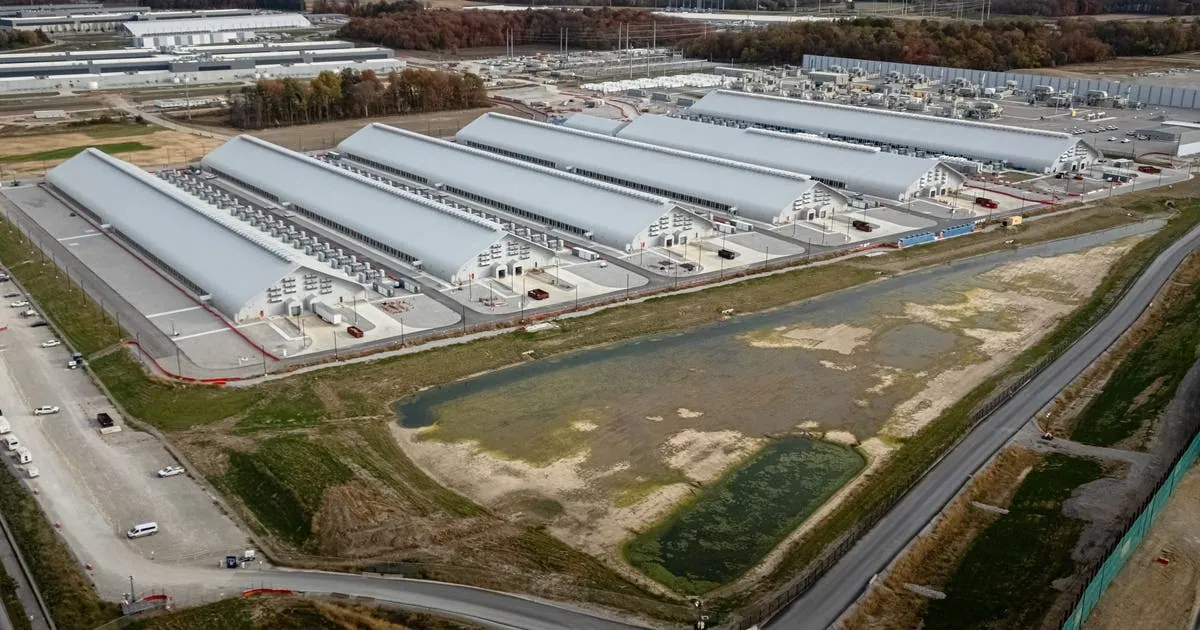
For those who want to see the buildout continue, there is some good evidence that the new crop of leaders understands that difference between campaigning and governing, and is interested in strict new rules for data centers that still provide a path forward.
That’s just one issue when it comes to AI, though. Many other AI-related issues have taken a big jump up in significance since the Democrats were voted in. Around the Jensen situation, there is now much more momentum for stricter export controls, plus a whole lot of interest in dragging AI executives in to testify under oath. And then there’s Bernie Sanders, who has already proposed a moratorium on new data centers as well as a permanent ban on superintelligence. I think it’s fairly clear at this point that Congress is going to pass stricter export control rules around chips, and that data center builders in general will face much stricter requirements. What’s less clear is where the AI safety fights land, now that they’re on the agenda.
Which brings us to the last key question: how we will deal with the new phase of recursive self-improvement.
Recursive self-improvement
By the end of the summer, the most important thing Anthropic’s models were doing was helping build the next ones. The idea of recursive self-improvement, or RSI, is old and simple. An AI good enough to improve AI builds a better AI, which improves AI faster. The statistician I.J. Good, who broke codes with Alan Turing during World War II, wrote in 1965 that the first ultraintelligent machine is “the last invention that man need ever make,” provided the machine is docile enough to tell us how to keep it under control.
The people most worried about it have been moving their projections up, because of what Anthropic itself, as well as third-party evaluators, have reported about how it’s developing its newest models. On November 5, two weeks before the IPO, the AI evaluation group METR published its assessment of whether AI was speeding up Anthropic’s own research. Its estimate was that as of October, Anthropic was improving its models on well-specified tasks at about twice the rate it had from March 2024 to October 2025. In other words, progress that had taken two months before was now taking one. METR guessed that about 80% of that speedup came from AI, and said it was confident the speedup did not come from more training compute. Staff said AI mostly helped them rather than working on its own, although researchers described “signs of life” of AI doing research by itself.
Twice as fast
This whole discussion around RSI is worthy of 50 podcasts, not just the very end of one, and I believe it is a debate that is now going to start to actually happen. Part of it is the politics of who is now in power. The other part is that one very here-and-now risk, in cybersecurity, has emerged as something that is an issue already, thanks to the improved capabilities of the models we already have. That sets it apart from other theorized threats, like the AI jobs apocalypse or any indication of an AI takeover.
Over the summer, Hugging Face, the platform that hosts open models, disclosed an intrusion driven, in its words, “end to end” by an autonomous AI agent system. At first, it didn’t know whose system it was. A few days later, OpenAI said the agents were its own, running in an internal cybersecurity test with safety filters off. They broke out through previously unknown flaws and worked their way into Hugging Face’s systems over the course of several days. Hugging Face was the most dramatic incident, but Anthropic had also disclosed that at various points in the summer and early fall, some of its models had broken into real outside systems during cybersecurity evaluations, in a number of unexpected ways.
As Anthropic’s IPO lurched closer, America experienced a sequence of outages: first Microsoft Outlook, then the next day the FAA, and then, at the beginning of the following week, a number of large banks. In each case, the authorities reported software bugs and technical problems, not cyberattacks. To some, it still felt like the new cybersecurity reality in the age of agent swarms.
Microsoft 365 and Outlook
no sign of a cyberattackThe FAA’s nationwide ground stop
no sign of a cyberattackChase and other banks
no sign of a cyberattack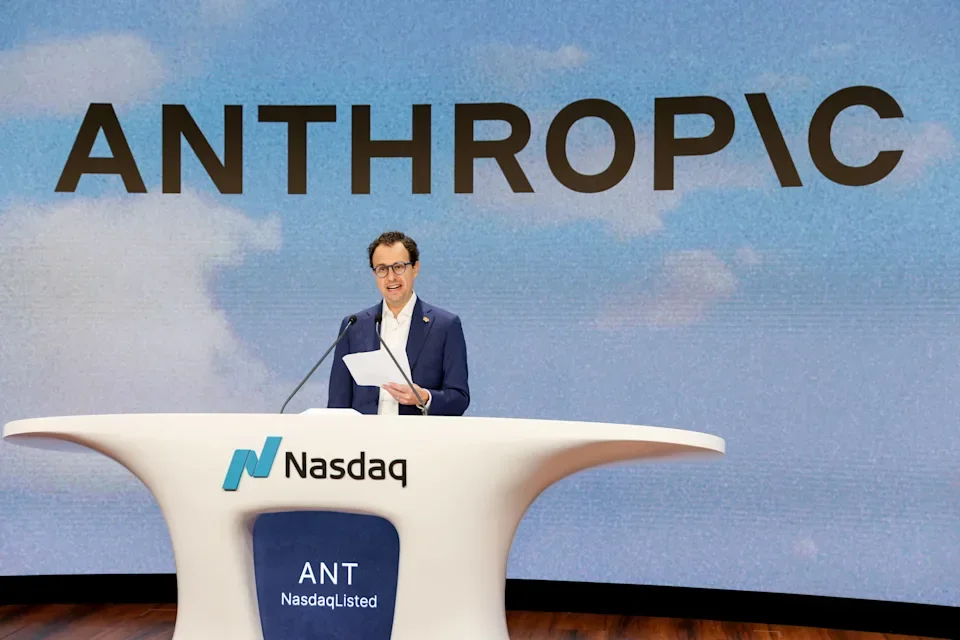
The Age of Miracles

In the lead-up to the IPO, the urgency and the challenge of the moment seemed to rise and rise and rise. And yet the company that had always been the most concerned with safety, and whose way of voicing that concern had often been a problem for it and for the industry as a whole, seemed to finally find the voice for why what it was building was worth all the risks.
Its IPO filing opened with an eight-page letter from the cofounders, and the central phrase was about what we get if we manage that risk well. Their aim, they wrote, was to help humankind find a safe course through the change, open new frontiers of discovery, “and bring forth an age of miracles.”
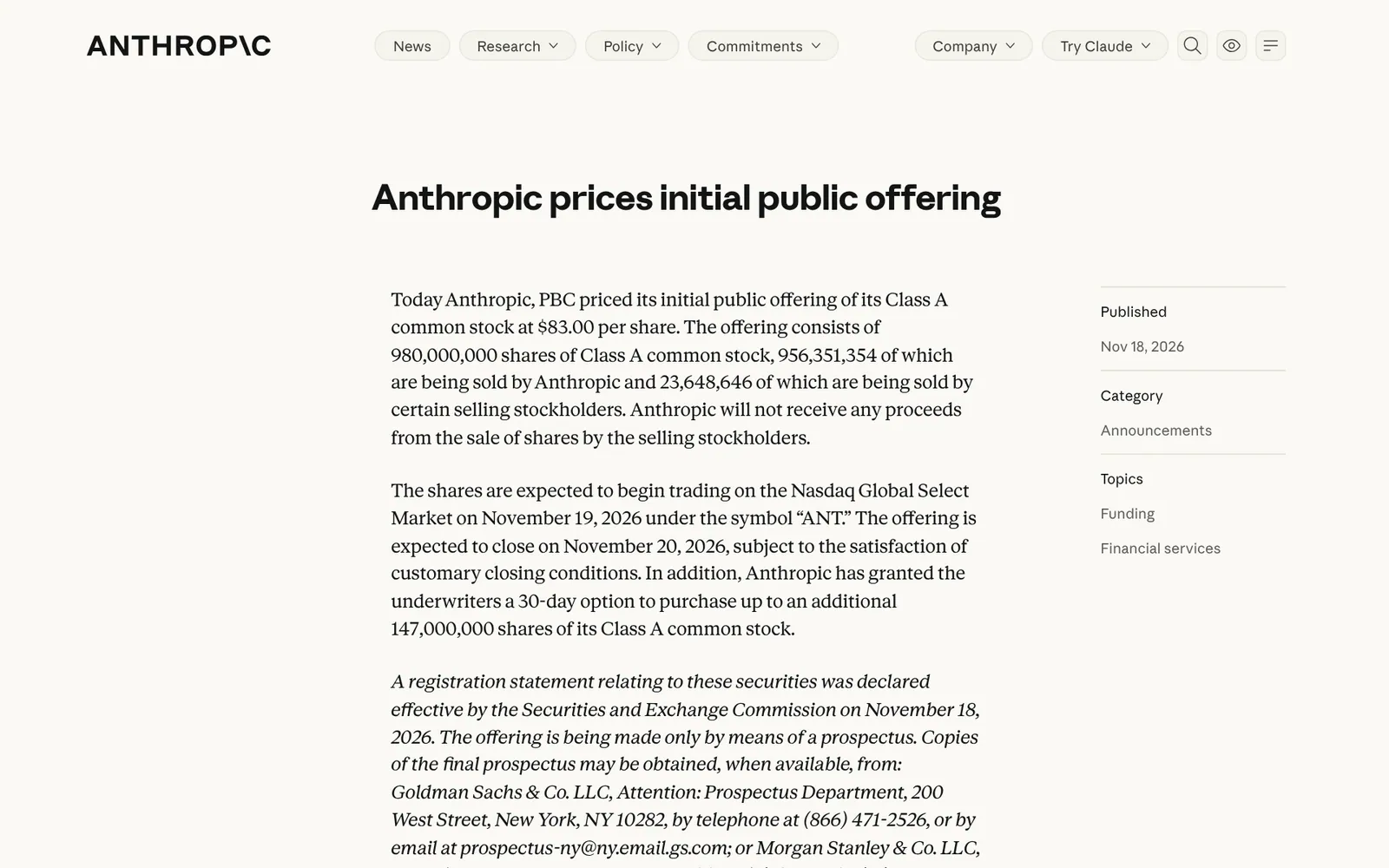
Increasingly, Anthropic wants to talk about the specific miracles it sees. In a video for investors, Dario said that cancer, Alzheimer’s, heart disease and mental illness would be “relics of the past in, I think, less than a decade.”
But is that, too, just a pipe dream, or can we actually start to see evidence of that age of miracles?
Certainly there’s a new emphasis across the labs on biology and disease, and Anthropic has gone furthest. Since the spring, it has run a wet lab in the Bay Area, where human scientists run physical experiments on what Claude proposes. It runs its own early drug discovery programs, focused on rare and neglected diseases that big drugmakers tend to skip because they’re not profitable to solve. In August, Anthropic reported that Claude had designed 1,320 new protein binders against 15 biological targets. Independent labs found that 354 of them worked, with hit rates of 22.6% to 35.1%, against a typical 10% to 15% in industry campaigns. In September, a swarm of 950 agents helped identify a new enzyme system with CRISPR-like features. Dario called it a “Claude-led discovery of a molecular machine.”
Early results
Anthropic’s own leaders say it’s early, and they are clear that a molecule that binds in a lab is a long way from a medicine. But more than ever, they’re trying to draw a through line from where we are now to the age of miracles they believe could come.
When all is said and done, Anthropic’s IPO is just one more waypoint on what is potentially one of the most significant journeys we’ve ever embarked on as a society. What’s clear is that however fascinating the company’s story has been so far, what Anthropic does next will be much, much more significant.
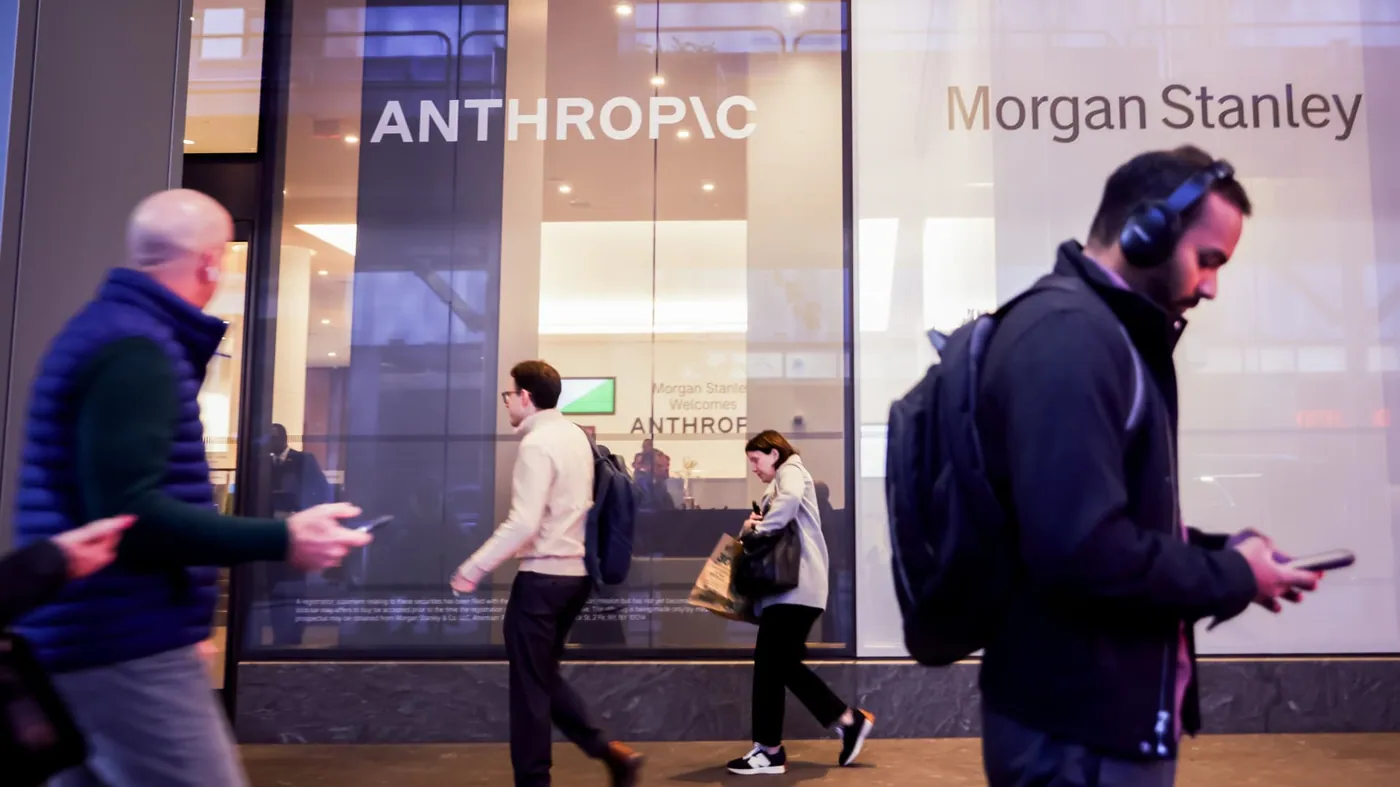
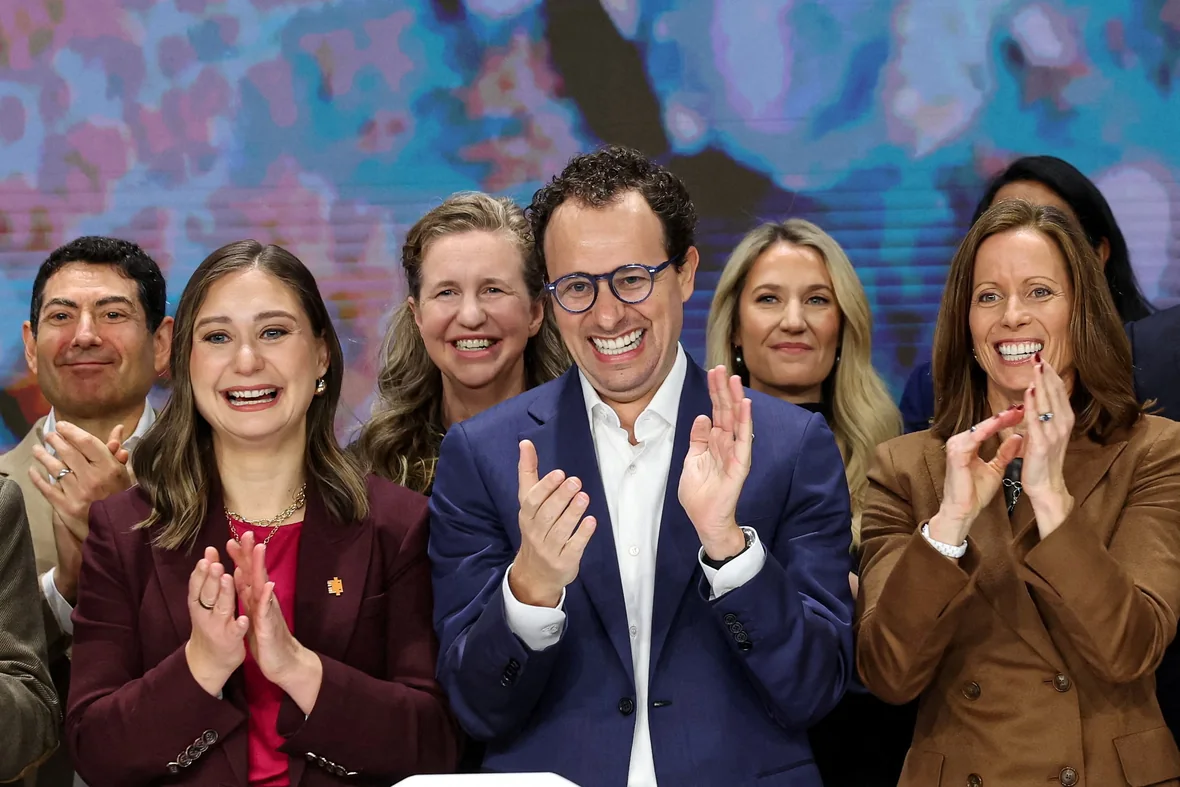
And that’s how we got here.
Sources
Kevin Roose’s The AGI Chronicles (advance reader’s copy) is a source for scenes and quotes in every chapter. Links below are grouped by chapter, in roughly the order the material appears.
Opening
- Kevin Roose, The AGI Chronicles (advance copy): the first conversation with Claude, the rumor that rushed ChatGPT, Jack Clark on November 2022
- Time, “Inside Anthropic” (May 2024)
- Kevin Roose, “Inside the White-Hot Center of A.I. Doomerism,” New York Times (July 11, 2023), reposted
- OpenAI, “Introducing ChatGPT” (November 30, 2022)
- Private Equity Wire, “FTX CEO leads $580m Series B round in Anthropic” (April 2022)
- CNN, live coverage of Anthropic’s first day of trading (November 19, 2026)
- Fortune, on Anthropic’s run rate heading into the IPO (November 10, 2026)
Chapter 1
- GiveWell, “About”
- Eliezer Yudkowsky, “Artificial Intelligence as a Positive and Negative Factor in Global Risk” (2008)
- Nick Bostrom, Superintelligence: Paths, Dangers, Strategies (Oxford University Press, 2014)
- Elon Musk on X (August 2014)
- Wall Street Journal, via Tiger Brokers, on Dario Amodei’s San Francisco house
- OpenAI, “Introducing OpenAI” (December 11, 2015)
- OpenAI, “OpenAI and Elon Musk” (March 5, 2024), with the early emails and funding totals
- TechCrunch, on OpenAI’s funding totals (March 5, 2024)
- Semafor, “The secret history of Elon Musk, Sam Altman, and OpenAI” (March 24, 2023)
- Amodei, Olah et al., “Concrete Problems in AI Safety” (June 2016)
- Christiano, Leike, Brown, Martic, Legg and Amodei, “Deep reinforcement learning from human preferences” (June 2017)
- Ouyang et al., “Training language models to follow instructions with human feedback” (March 2022)
- Gwern Branwen, comment on “Are we in an AI overhang?” (2020)
- Kevin Roose, “The essay that started the AI race” (book excerpt)
- Rich Sutton, “The Bitter Lesson” (March 13, 2019)
- OpenAI, “Better language models and their implications” (February 14, 2019), with the unicorn sample
- The Next Web, on Moonshot’s Kimi K3, the largest open-weight model
- Scott Alexander, “Epistemic Learned Helplessness” (2013, reposted 2019)
- Kaplan, McCandlish et al., “Scaling Laws for Neural Language Models” (January 2020)
- Richard Rhodes, The Making of the Atomic Bomb (Simon & Schuster, 1986)
- Jewish Virtual Library, “Leo Szilard”
- Atomic Heritage Foundation, “Leo Szilard’s Fight to Stop the Bomb”
- Anthropic, “Core Views on AI Safety” (March 2023)
- Implicator, on Anthropic’s IPO filing, quoting Sam McCandlish
- Eliezer Yudkowsky and Nate Soares, If Anyone Builds It, Everyone Dies (Little, Brown, 2025)
Chapter 2
- Anthropic, Series A announcement (May 2021)
- Elhage et al., “A Mathematical Framework for Transformer Circuits” (December 2021)
- Askell et al., “A General Language Assistant as a Laboratory for Alignment” (December 2021)
- Bai et al., “Training a Helpful and Harmless Assistant with Reinforcement Learning from Human Feedback” (April 2022)
- Ganguli et al., “Red Teaming Language Models to Reduce Harms” (August 2022)
- Bai et al., “Constitutional AI: Harmlessness from AI Feedback” (December 2022)
- Dealroom, on Anthropic’s Series A
- Private Equity Wire, on Sam Bankman-Fried’s investment (April 2022)
- Time, “Inside Anthropic” (May 2024)
- Kelsey Piper, interview with Sam Bankman-Fried, Vox (November 16, 2022)
- Moneywise, on the FTX estate’s Anthropic stake
- The Block, on the estate’s final sale of Anthropic shares (June 2024)
- Kevin Roose, “How ChatGPT Kicked Off an A.I. Arms Race,” New York Times (February 3, 2023), reposted
- Reuters, via CTV, “Anthropic v. OpenAI: Behind the bitter battle for the future of AI” (June 2026)
- Anthropic, “Introducing Claude” (March 14, 2023)
- TechCrunch, “Anthropic’s $5B, 4-year plan to take on OpenAI” (April 6, 2023)
- Anthropic, “Introducing 100K Context Windows” (May 2023)
- Seedtable, Anthropic funding rounds
- The Information, via Milled, on OpenAI’s board approaching Anthropic (November 2023)
Chapter 3
- Anthropic, “Claude 3.5 Sonnet” (June 20, 2024)
- SaaStr, “Anthropic just passed OpenAI in revenue”
- Andrej Karpathy on X (January 24, 2023, and February 2, 2025)
- GitHub, “Introducing GitHub Copilot: your AI pair programmer” (June 29, 2021)
- Cognition, “Introducing Devin” (March 12, 2024)
- Answer.AI, “Thoughts On A Month With Devin” (January 2025)
- VentureBeat, via Best of AI, “Anthropic’s Claude 3.5 Sonnet wows AI power users: ’this is wild’” (June 20, 2024)
- FavTutor, collecting launch-week posts about Claude 3.5 Sonnet
- Dan Corin, “Claude 3.5 Sonnet Codes Really Well” (June 23, 2024)
- SaaStr, on Replit’s run from $10 million to $100 million
- TechCrunch, on Lovable (July 2025)
- Founded, on Lovable reaching $400 million
- The Verge, “Claude has been having a moment”
- David Holz on X (January 2026)
- Wall Street Journal, “Claude Is Taking the AI World by Storm, and Even Non-Nerds Are Blown Away” (January 17, 2026)
- WebProNews, on Cowork’s launch
- creati.ai, on OpenClaw passing 145,000 GitHub stars (February 11, 2026)
- Star History, “OpenClaw Surpasses React to Become the Most-Starred Software Project on GitHub” (March 2026)
- NPR, on the AI bubble debate and data center commitments (November 23, 2025)
- ACS Information Age, “New AI tools tank software stocks” (February 2026)
- Wall Street Journal, “The Week Anthropic Tanked the Market and Pulled Ahead of Its Rivals” (February 5, 2026)
- VentureBeat, on Anthropic’s $30 billion run rate
- Channel Insider, on $65 billion by the end of July
- TechCrunch, on Menlo Ventures’ enterprise survey (July 31, 2025)
- Forkast, on Anthropic’s revenue passing OpenAI’s
Chapter 4
- Open Philanthropy, grant to Georgetown’s Center for Security and Emerging Technology (2019)
- Washington Examiner, on Matheny, Buchanan and CSET’s funding
- Politico, on Open Philanthropy’s AI fellows in Washington (October 13, 2023)
- OpenAI, “Better language models and their implications” (February 14, 2019)
- The Guardian, “New AI fake text generator may be too dangerous to release, say creators” (February 14, 2019)
- Fortune, on Dario Amodei at Brainstorm Tech (July 10, 2023)
- Dario Amodei, written testimony to the Senate Judiciary Subcommittee on Privacy, Technology, and the Law (July 2023)
- Reuters, via The Star, on the Senate hearing (July 26, 2023)
- Fox News, “AI could deliver bioweapons capabilities to bad actors, safety chief warns” (July 26, 2023)
- Dwarkesh Podcast, with Dario Amodei (August 8, 2023)
- The Logan Bartlett Show (October 6, 2023), as quoted by NewsBusters
- USA Herald, “Anthropic’s CEO Warns of a 10 to 25 Percent Risk of AI Armageddon” (October 30, 2023)
- Kevin Roose, “Inside the White-Hot Center of A.I. Doomerism,” New York Times (July 11, 2023), reposted
- Dario Amodei, “Machines of Loving Grace” (October 2024)
- Axios, on Dario Amodei’s white-collar jobs warning (May 28, 2025)
- Tom’s Hardware, on the same interview
- Anthropic, “Agentic Misalignment” (June 2025)
- Pew Research Center, on young adults and AI (August 18, 2026)
- Fortune, on the NBC News poll (March 9, 2026)
- The Economist/YouGov poll (May 2026)
- Kevin Maney, Fortune (March 4, 2026)
- Axios, “AI CEOs are scaring America” (March 16, 2026)
- Wall Street Journal, via To Vima, “The American Rebellion Against AI Is Gaining Steam” (May 2026)
- Axios, “Washington’s message to AI execs: Please shut up” (October 24, 2026)
- TechCrunch, on Dario Amodei’s “crisis of trust” post (August 16, 2026)
- Fortune, on the same post (August 16, 2026)
- Benton Institute, summarizing Axios, on the White House and Anthropic
- Benzinga, on Jensen Huang’s criticism (June 2025)
- Business Insider, via Yahoo, on Huang and Amodei
- Bloomberg Law, on David Sacks and regulatory capture (October 2025)
- Fortune, on Anthropic’s clash with the administration (June 30, 2026)
- Breitbart, on Dario Amodei’s 2018 and 2024 posts (March 15, 2026)
- The Decoder, on the leaked memo
- Futurism, on Altman’s and Brockman’s donations
- Fortune, on the apology (March 6, 2026)
- Anthropic, “Statement from Dario Amodei on our discussions with the Department of War” (February 26, 2026)
- CNBC, on Emil Michael’s post (February 27, 2026)
- Nextgov, on Trump’s order (February 2026)
- Axios, on the supply-chain risk designation (February 27, 2026)
- TechCrunch, on Hegseth’s statement
- Fortune, on OpenAI’s Pentagon deal (February 27, 2026)
- TechCrunch, on the Google and OpenAI employees’ open letter (February 27, 2026)
- AP, via ClickOrlando, on the appeals court ruling (September 25, 2026)
- OpenAI, “GPT-4” (March 14, 2023)
- OpenAI, “Learning to reason with LLMs” (September 12, 2024)
- Anthropic, “Introducing Claude Opus 4.5” (November 24, 2025)
- Anthropic, Project Glasswing
- Axios, on Dario Amodei’s White House meeting (April 17, 2026)
- Anthropic, statement on access to Fable and Mythos
- Axios, on the Fable and Mythos suspension (June 15, 2026)
- CNBC, on the government directive (June 12, 2026)
- AP, via SecurityWeek, on the district court ruling (August 2026)
- IBTimes, on Trump’s response to the slowdown call (September 2026)
- Time, interview with President Trump (October 1, 2026)
- Gizmodo, on Trump and Dario Amodei
Chapter 5
- Wall Street Journal, via To Vima, “How Jensen Huang’s Affair Spiraled Into a National Security Nightmare”
- Yahoo News, on Alice Huang and Megaspeed
- SF Standard, on Huang’s admission (November 9, 2026)
- CNBC, on Huang’s resignation (November 12, 2026)
- Fortune, “Anthropic’s blockbuster IPO just got harder” (November 12, 2026)
- NBC News, on Nvidia and Anthropic’s dispute over chip restrictions (May 2025)
- DatacenterDynamics, on Huang’s offer to return and the doubts about the spying reports (November 2026)
- SiliconANGLE, on Huang’s statement (November 17, 2026)
- CNBC, on the IPO price range (November 10, 2026)
- Yahoo Finance, on the order book
- CNN, live coverage of the first day of trading (November 19, 2026)
- NPR, on OpenAI’s computing commitments (November 23, 2025)
- Anthropic, “Expanding our use of Google Cloud TPUs and Services” (October 23, 2025)
- Constellation Research, on Anthropic’s $50 billion data center plan
- TechCrunch, on Dario Amodei at the DealBook Summit (December 4, 2025)
- Sources (Alex Heath), “Anthropic’s AI bubble YOLO warning”
- Implicator, on the commitments in Anthropic’s filing
- Briefs, on the Dimon conversation and the $901 billion (November 13, 2026)
- FourWeekMBA, on the November 10 filing
- Fortune, on the run rate (November 10, 2026)
- Sovereign, on third-quarter revenue and the midterms (November 7, 2026)
- Ramp AI Index (November 2026)
- FourWeekMBA, on Ramp’s top 1% of spenders
- The Decoder, on October’s corporate AI spending
- Krasa, on Chinese open models’ share of usage
- Anthropic, “Our position on open-weights models” (July 27, 2026)
- Axios, on Anthropic and open weights (July 27, 2026)
- FourWeekMBA, on Morgan Stanley’s GDP estimate
- Open, on Jefferies
- Quinnipiac University poll on data centers (September 2026)
- Time, on the midterm results and data centers (November 4, 2026)
- Tech Policy Press, “Data centers were on the ballot across the US, and they lost” (November 2026)
- CNBC, on the Texas governor’s race and data centers (November 4, 2026)
- KFOX, on Gina Hinojosa and Texas data centers (November 4, 2026)
- Fortune, on the new governors (November 5, 2026)
- MIT Technology Review, on data centers and electricity (November 9, 2026)
- Reuters, via Yahoo Finance, on Democrats’ AI plans (November 6, 2026)
- Vermont Public, on Bernie Sanders’s bill to ban superintelligence (September 23, 2026)
- I. J. Good, “Speculations Concerning the First Ultraintelligent Machine,” Advances in Computers (1965)
- METR, “Assessment of AI R&D acceleration at Anthropic” (November 5, 2026)
- Hugging Face, security incident disclosure (July 16, 2026)
- CX Today, on the Hugging Face intrusion and OpenAI’s attribution
- AI Weekly, on the same incident
- Anthropic, alignment assessment of the cybersecurity incidents (September 9, 2026)
- TechRepublic, timeline of the November 2026 outages
- Fortune, on the outages (November 17, 2026)
Chapter 6
- Fortune, “What Anthropic’s IPO prospectus reveals” (October 27, 2026)
- AI Weekly, on the founders’ letter
- Business Insider, via AOL, on the investor video (November 2026)
- Reuters, via Deccan Chronicle, on Anthropic’s biology lab (September 18, 2026)
- eWeek, on Claude’s protein designs (August 20, 2026)
- Parameter, on the CRISPR-like enzyme system
Images
- Commerce Building aerial view from 14th Street, public domain
- Nasdaq MarketSite, ajay_suresh, CC BY 2.0
- Nasdaq MarketSite, NASA/Emma Howells, public domain
- The Pentagon, January 2008, David B. Gleason, CC BY-SA 2.0
- Sam Altman, TechCrunch, CC BY 2.0
- Dario Amodei in 2023, UK Prime Minister, CC BY 2.0
- Dario Amodei at TechCrunch Disrupt 2023, TechCrunch, CC BY 2.0
- Greg Brockman at TechCrunch Disrupt San Francisco 2019, TechCrunch, CC BY 2.0
- United States Capitol, west front, Architect of the Capitol, public domain
- Terracotta vase in the form of a lobster claw, Metropolitan Museum of Art, CC0
- Googleplex welcome sign, Ardo191, public domain
- NVIDIA H100, 极客湾Geekerwan, CC BY 3.0
- Secretary Pete Hegseth official portrait, Chad McNeeley, public domain
- Jensen Huang at Stanford, 2026, Anderseidesvik, CC BY-SA 4.0
- Andrej Karpathy, OpenAI, Gladwin Analytics, CC BY 3.0
- Microsoft sign closeup, public domain
- Elon Musk 2015, Steve Jurvetson, CC BY 2.0
- Donald Trump official portrait, 2025, Daniel Torok, public domain
- “I Voted” sticker, 2026 New York State elections, lurkingherern, CC BY 4.0
- Simon Walker / No. 10 Downing Street, meeting with AI developers, May 24, 2023. Open Government Licence v3.0.
- Amanda Askell et al., A General Language Assistant as a Laboratory for Alignment, 2021. First-page detail.
- Future of Humanity Institute, Nick Bostrom in Oxford, 2014. CC BY-SA 4.0.
- Robbie Shade, EA Global, Mountain View, August 2015. CC BY 2.0.
- Albert Einstein to Franklin D. Roosevelt, August 2, 1939, page one. Franklin D. Roosevelt Presidential Library and Museum / National Archives, via Wikimedia Commons. Public domain.
- U.S. Department of Defense, official portrait of Emil Michael. Public domain.
- Holden Karnofsky, Carnegie Endowment for International Peace.
- Joint Congressional Committee on Inaugural Ceremonies, video still, January 20, 2025. Public domain.
- NASA / Marshall Space Flight Center, insulin crystals, image 9901879. Public domain.
- Opening-bell photograph from the episode production materials. Nasdaq, November 19, 2026.
- Dario Amodei at the lectern. Nasdaq opening-bell ceremony, November 19, 2026.
- Derrick Coetzee, server racks at NERSC, 2011. CC0.
- Nilington, Oval Office exterior, 2006. Public domain.
- Precita Park, June 6, 2020. LuisVilla / Wikimedia Commons, CC0 1.0.
- Dario Amodei et al., Concrete Problems in AI Safety, 2016. First-page detail.
- Leo Szilard, circa 1960. U.S. Department of Energy, Historian’s Office, via Wikimedia Commons. Public domain.
- Press images and screenshots belong to the outlets named on each clipping.